
2026-06-24 Wed
The Lichhavi clan traces its origins to the ancient republican Licchavis of Vaishali which is in present-day Bihar. They are known from the time of the Buddha. A branch of this clan is believed to have migrated northward, possibly due to political pressures and established its authority in the Kathmandu Valley. They introduced a more structured monarchy, adopted Sanskrit as the court language, and strengthened cultural and religious connections with India, while also maintaining ties with Tibet.
The Lichhavi Kingdom flourished roughly between 450 and 750 CE and is often regarded as Nepal’s Golden Age. This period witnessed significant progress in art, architecture, administration, trade, and cultural development.
The Lichhavis were the first rulers in Nepal to issue coins, inspired from Indian traditions, particularly the Kushan and Gupta styles. They minted copper coins, including tetradrachm, under rulers such as Manadeva. These coins commonly featured motifs like lions, Garuda, and the goddess Lakshmi.
Coins attributed to King Amsuvarman display symbols such as a winged lion and a bull, with inscriptions in Brahmi or Gupta script, including legends like Sri Amsuvarma.
King Manadeva I is credited as the first ruler to issue coins and record royal edicts. A devotee of Vishnu, he also contributed to temple construction and public works.
The Mananka series, dating from approximately the 5th to 7th century, marks the beginning of Nepal’s documented coinage history. The term Mananka is derived from the Brahmi/Gupta legend Sri Mananka, meaning “The Mark of Mana” or “Glorious Mana,” likely referring to a ruler or a symbolic royal mark. These coins were typically struck in copper or copper-iron alloy.
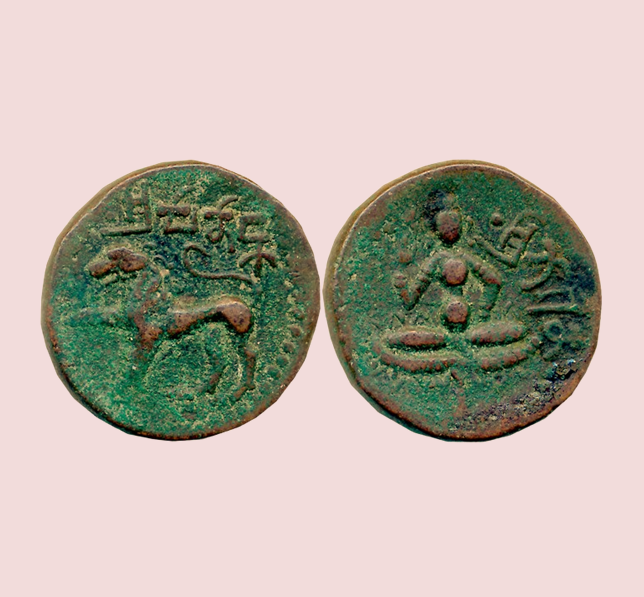
Mananka series coins generally feature a lion standing to the left with its right forepaw rose which is a symbol of authority and royalty along with the Brahmi legend Sri Mananka on the obverse. The reverse usually depicts a seated female figure, often identified as Bhogini that possibly a queen or a goddess such as Lakshmi, usually seated on a lotus, with the legend Sri Bhogini or sometimes another Sri Mananka. These coins were produced using the hammer-striking technique. These coins are rare and highly valued by collectors; they serve as important historical evidence for Lichhavi art, governance, and culture, alongside contemporary stone inscriptions.
The copper unit from the Lichhavi Kingdom, belonging to the Mananka series, weighs 9.65 grams. The obverse shows a lion standing to the left with its right forepaw rose, accompanied by the Gupta Brahmi legend Sri Mananka. The reverse depicts a female deity seated cross-legged on a lotus, with the Brahmi legend Sri Bhogini to the right.
-
Goddess Laxmi holding Lotus and feeding Peacock on the Kumargupta I’s Gold Coin
2026-10-23 FriThe Gupta Empire (4th–6th centuries CE) occupies a distinguished place in Indian history, renow...
-
Chola Influence on Sri Lankan Coinage through Gold Kahavanu
2026-10-23 FriThe history of Sri Lankan coinage offers fascinating insights into the political, commercial and ...
-
Bronze Coin of Zeionises, Kshatrapa of Chuksa
2026-10-22 ThuThe Indo-Scythians, also known as the Sakas, were Central Asian peoples who migrated into the nor...
-
Silver Drachma of the Western Kshatrapas Ruler Viradaman
2026-10-22 ThuThe Western Kshatrapas were an important dynasty that ruled parts of western and central India, p...
-
Silver Tetradrachm of the Northern Kshatrapas
2026-10-21 WedThe Kshatrapas of Kashmir form part of the fascinating history of the northwestern Indian subcont...