
2026-06-24 Wed
Step into the story of the Namgyal dynasty, the royal line that ruled Sikkim as Chogyals which means spiritual kings from 1642 until the monarchy ended in 1975. For over 330 years, this Tibetan Buddhist dynasty shaped the culture and identity of the Eastern Himalayas.
But where did it all begin?
Legend takes us back to the 14th century, when Khye Bumsa also known as Guru Tashi, a prince from the Minyak House in Kham (eastern Tibet), journeyed south to Sikkim, guided by a divine prophecy. From this remarkable beginning, his descendants slowly built their legacy, bringing together the Lepcha, Limbu, and other communities under their rule.
Phuntsog Namgyal (1604–1670) was crowned at Yuksom, capital of the state as the first Chogyal by three revered Tibetan lamas who arrived from the north, west, and south.
The copper mine of Tukkhani served as a source of raw material for minting coin. The coinage can be classified into Dooba Paisa and Chepte Paisa. Dooba Paisa was irregular in shape, minimally inscribed, and circulated for local use. Chepte Paisa was circular and inscribed in Devanagari script.
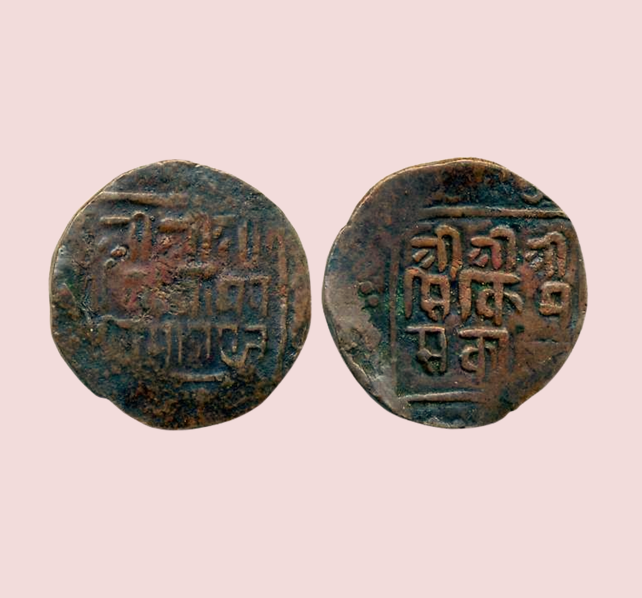
Thutob Namgyal was the 9th Chogyal of Sikkim. He ruled from 1874 until his death in 1914. He shifted the capital to Gangtok. Coins from his reign bear his name in Nagari script.
Coins of Thutob Namgyal feature the legend Sri Sri Sri Sikimapati Maharaj in Devanagari on the obverse and Sri Sri Sri Sikima Sarkar on the reverse. The denomination is 1 paisa, equivalent to 1/64 of a rupee.
The copper paisa shown above weighs 5.15 grams. The legends on both sides are arranged in three lines within a square, with the date placed below.
-
Mananka Coin Series of Lichhavi, King Manadeva I
2026-06-24 WedThe Lichhavi clan traces its origins to the ancient republican Licchavis of Vaishali which is in ...
-
Extremely Rare Silver Quarter Tanka of Kachar Monarch Yasho Narayan, Owing Allegiance to Ghatotkacha Lineage
2026-06-23 TueHidden within the misty valleys and forested hills of Northeast India lies the story of the Kacha...
-
Gun and Sword on Silver Katra Taka of Independent Kingdom of Jaintiapur King Bar Gossain II
2026-06-22 MonThe Jaintia was a prominent medieval Independent Kingdom in Northeast India, ruled ...
-
Rare and Beautiful Gold Dinar of Gauda Ruler Shashanka
2026-06-19 FriThe Gauda dynasty was an ancient kingdom in the Gauda region of Bengal. It emerged as an independ...
-
Exceptional Gold Mohur of Ahom King Swargdeo Rajeshwar Singha
2026-06-19 FriThe Ahoms were ethnic group originating from the Tai people and founder of Assamese royal dynasty...