
2026-06-23 Tue
Hidden within the misty valleys and forested hills of Northeast India lies the story of the Kachar, or Dimasa Kingdom, a powerful yet often overlooked realm shaped by the Bodo-Kachari people. Stretching across the southern banks of the Brahmaputra River, from the Dhansiri Valley to the North Cachar Hills and beyond, this kingdom quietly expanded its influence over present-day Assam, Nagaland, and the fertile Cachar plains, leaving behind a legacy engraved more on coins than in written records.
With few written records to narrate its past, the true voice of the Kachar Kingdom survives through its coinage. Their legendry origins are linked with the Ghatotkacha who was the son of Bhima and Hidimba from the Mahabharata. They claimed descent from the Hachengsa (or Hatsungtsa) clan. These silver tankas, minted between the early 16th and 19th centuries, are more than currency as they are storytellers in their own right. They reveal fragments of political power, clan legitimacy, and dynamic interactions with neighboring kingdoms like Bengal, Tripura, Koch, and the Ahoms.
Kachari coins are typically struck on round flans, with legends in Bengali or Sanskrit script arranged in lines within squares or bordered designs. The inscriptions are often devotional, invoking deities such as Hara-Gauri (Shiva–Durga), and include royal titles like “Narayan,” as well as clan references such as “Hachengsa/Ha-tsung-tsa Vamsaja” of the Hachengsa lineage, along with Saka era dates. The reverse often names the king as “Bhupalasya.” These coins are highly valued in numismatics for their distinctiveness, rarity, and their role in illuminating the medieval history of Northeast India.
Yasho Narayan was a prominent ruler and is regarded as one of the most powerful Dimasa kings. He achieved notable military successes, after which he assumed the title Pratap Narayan to signify his prowess. He also defeated the Jaintia king Dhan Manik and installed Jasa Manik on the Jaintia throne. These actions brought the Dimasa Kingdom into further conflict with the Ahoms around 1618.
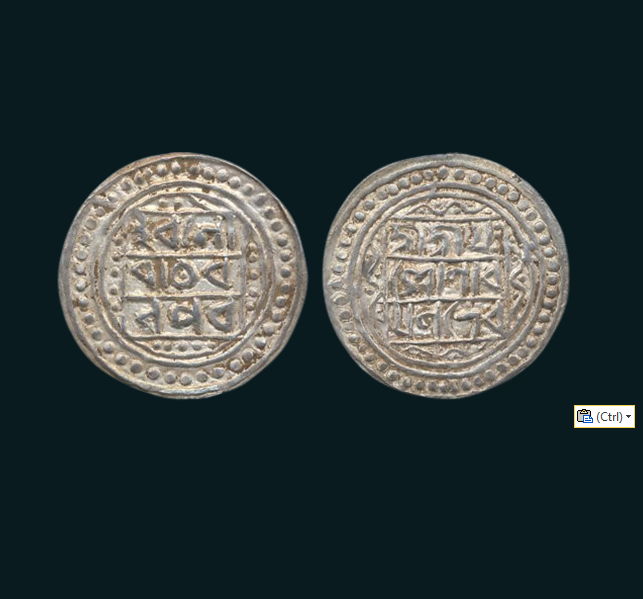
He issued silver 1/4th tankas, which serve as important numismatic evidence of Kachari independence and legitimacy. His coins typically feature devotional legends invoking Hara-Gauri, references to the Hachengsa (or Ha-tsung-tsa) lineage, royal titles, and sometimes date.
This particular Quarter Tanka weighs 2.67 grams. The Bengali legend can be seen on both sides, arranged within a double circle surrounded by dots. The obverse legend reads Haragauri Charana para, while the reverse legend readsShri Shri Yasho Narayan Deva.-
Gun and Sword on Silver Katra Taka of Independent Kingdom of Jaintiapur King Bar Gossain II
2026-06-22 MonThe Jaintia was a prominent medieval Independent Kingdom in Northeast India, ruled ...
-
Rare and Beautiful Gold Dinar of Gauda Ruler Shashanka
2026-06-19 FriThe Gauda dynasty was an ancient kingdom in the Gauda region of Bengal. It emerged as an independ...
-
Exceptional Gold Mohur of Ahom King Swargdeo Rajeshwar Singha
2026-06-19 FriThe Ahoms were ethnic group originating from the Tai people and founder of Assamese royal dynasty...
-
Heavy Lead Coin of Hiranyakas, King Khadakama
2026-06-18 ThuThe Hiranyakas were a local dynasty that rose in the mid-3rd century CE, in Rayalaseema region th...
-
Lead Coin of Satavahana, Ruler Siri Satakarni
2026-06-18 ThuThe Satavahanas were a major ancient Indian dynasty that ruled large parts of the Deccan i.e. sou...