
2026-06-22 Mon
The Jaintia was a prominent medieval Independent Kingdom in Northeast India, ruled by the Pnar people. It encompassed the present-day West and East Jaintia Hills districts of Meghalaya, India, and extended into the plains of the Surma/Barak Valley in modern-day Bangladesh. Its origins can be traced to the Austroasiatic linguistic group, and its society traditionally followed a matrilineal system.
The kingdom had two capitals, Nartiang and Jaintiapur, which served as the summer and winter capitals, respectively. Nartiang, located in the Meghalaya hills, is known for its megalithic monoliths and the Durga Temple. Jaintiapur, now in Bangladesh, functioned as an administrative and trade hub.
The Jaintia rulers issued silver coins which reflect Hindu religious influences, martial symbolism, and the kingdom’s political autonomy amid interactions with neighboring powers such as the Koch, Ahom, and Kachari kingdoms, and later the British. Most of their coins were debased silver tankas, typically weighing approximately 8.5–10 grams, along with fractions such as the ¼ rupee. Gold coins (mohor/ksiar) are mentioned in tradition but are rare or less well documented among surviving specimens. Silver coins were locally known as Shan-Mohor or Katra Taka (meaning "sword tanka"), referring to their distinctive motifs.
The inscriptions on Jaintia coins are usually in Bengali/Assamese script but composed in the Sanskrit language. They often contain devotional phrases invoking Shiva, such as "Sri Sri Shiva Charana Kamala Madhukarasya," meaning "devoted to the lotus feet of Shiva." The reverse typically bears the legend "Sri Sri Jayantipura Purandarasya," referring to Purandara of Jayantipura. Other prominent features include a six-pointed star, sword, gun, floral elements, dotted mint marks, and occasionally five-pointed stars. The borders are often decorated with beaded or circular patterns.
Bar Gossain II reigned from 1731 to 1770 CE. His coins are prized by collectors for their rarity and historical value. They help reconstruct ruler chronologies where written records are limited.
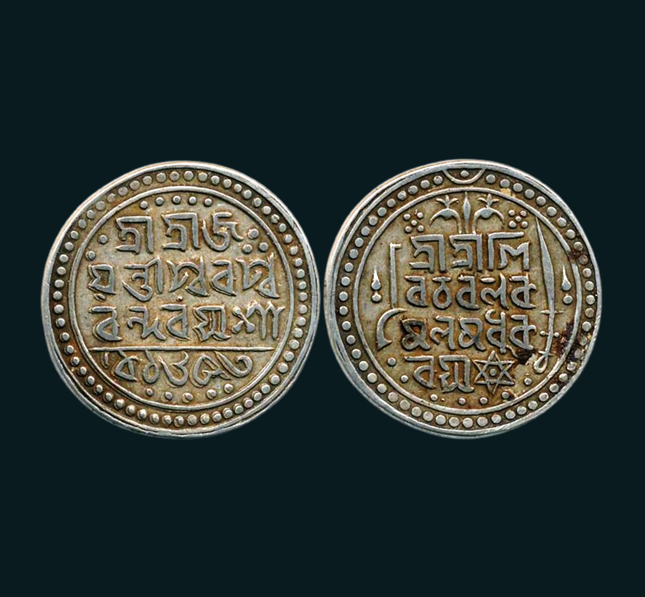
The above silver rupee of Bar Gossain II weighs 9.45 grams. The obverse depicts the legend "Sri Sri Shiva Charana Kamala Madhukarasya" along with a star, a sword on the right, and a gun on the left margin. The reverse bears the legend "Sri Sri Jayantipura Purandarasya, Saka 1653"
-
The Elephant on an Indo-Greek Silver Drachm of Apollodotus I
2026-09-22 TueElephants were not just an important part of Indian heritage and religious traditions; they also ...
-
Gajalakshmi Flanked by Elephants on a Post-Mauryan Ujjaini Copper Coin
2026-09-22 TueThe association between Gajalakshmi and elephants is one of the most enduring motifs in Indian re...
-
Elephant Head on a Bronze Coin of Indo-Scythian King Maues
2026-09-21 MonAs the eighth day of Ganesh Utsav is celebrated, the elephant once again provides a fascinating l...
-
A Remarkable Elephant-and-Lion Standard on Vrishni Coinage
2026-09-21 MonAs Ganesh Utsav continues, the elephant once again offers a fascinating doorway into India’s an...
-
Elephant and Lion on a Cooch Behar Royal Coin
2026-09-19 SatThe elephant occupies a distinctive place in the cultural traditions of eastern India, particular...