
2026-06-19 Fri
The Gauda dynasty was an ancient kingdom in the Gauda region of Bengal. It emerged as an independent power in the late 6th to early 7th century CE, following the decline of the Gupta Empire. Its capital was Karnasuvarna, located near present-day Murshidabad in West Bengal. The Gauda dynasty is referenced in ancient texts such as the Arthashastra, the Puranas, and in the works of Panini and Varahamihira.
The coinage of the Gauda Dynasty is one of the significant sources of information about this early independent kingdom of Bengal. These coins were issued after the fall of the Gupta Empire and display strong Shaivite influences. Many coins depict Lord Shiva in various postures, often accompanied by symbolic elements. The inscriptions are in Brahmi script. The dynasty issued primarily gold dinars, along with a limited number of silver coins. Although their gold dinars are of relatively lower purity, they exhibit excellent artistic quality and typically weigh between 5.5 and 9.5 grams.
The coins proclaim Shashanka as Maharajadhiraja. They were minted at Karnasuvarna, while coins of the Samatata type are believed to have been minted in the Assam region.
Shashanka (?a??nka) was the most prominent ruler of the dynasty and is often regarded as the first independent king of Bengal. He is credited with establishing a unified political entity in the region. He was a devouted Shaivite which is also reflected in his coinage. His reign is linked to the origin of the Bengali calendar. He issued both gold and silver coins.
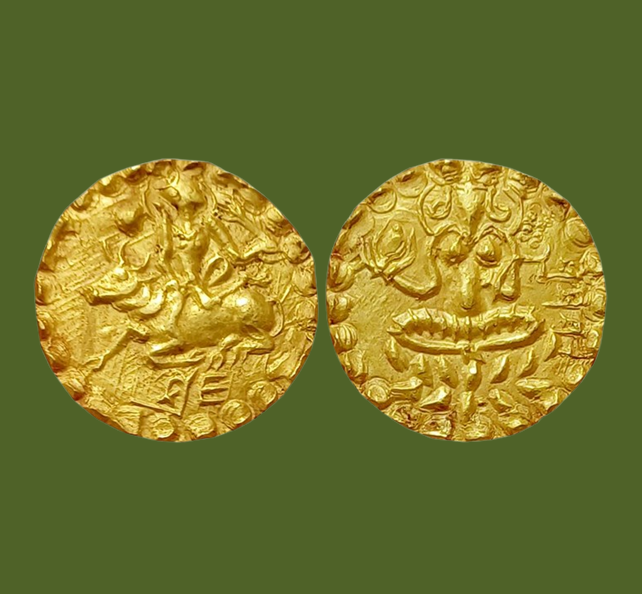
The gold dinar described above weighs 5.85 grams. The obverse depicts Lord Shiva reclining on a couchant bull, with the Brahmi legend “Sri Ja” below the bull. A large dot, apparently representing the moon, appears to the left of Lord Shiva’s face, all enclosed within a circular dotted border. The reverse features Goddess Lakshmi seated on a lotus, holding a lotus bud in her left hand and a conch shell in her right hand. The Brahmi legend “Sri-Sasanka” appears in the left field.
-
The Elephant on an Indo-Greek Silver Drachm of Apollodotus I
2026-09-22 TueElephants were not just an important part of Indian heritage and religious traditions; they also ...
-
Gajalakshmi Flanked by Elephants on a Post-Mauryan Ujjaini Copper Coin
2026-09-22 TueThe association between Gajalakshmi and elephants is one of the most enduring motifs in Indian re...
-
Elephant Head on a Bronze Coin of Indo-Scythian King Maues
2026-09-21 MonAs the eighth day of Ganesh Utsav is celebrated, the elephant once again provides a fascinating l...
-
A Remarkable Elephant-and-Lion Standard on Vrishni Coinage
2026-09-21 MonAs Ganesh Utsav continues, the elephant once again offers a fascinating doorway into India’s an...
-
Elephant and Lion on a Cooch Behar Royal Coin
2026-09-19 SatThe elephant occupies a distinctive place in the cultural traditions of eastern India, particular...