
2026-06-19 Fri
The Ahoms were ethnic group originating from the Tai people and founder of Assamese royal dynasty. They established a powerful state in the Brahmaputra Valley of Assam. They ruled the region for almost 600 years from 1228 to 1826. They are the harbinger of modern Assamese identity, and they are known for their unique governance structures, and their military resilience. There were total 41 Kings during they 600 years of dynasty's reign.
Ahom coinage are unique and known for its octagonal shape. It was believed that the shape of Ahom kingdom was Octagonal. Hence, most of the silver and gold coins are found in octagonal shape with legend in Ahom, Devanagari and occasionally in Persian. Few coins are found in rectangular shape. They always used Shaka dates on their coinage.
Swargadeo Rajeswar Singha (Simha) (c 1751 to 1769 CE) , also known by his Ahom name as Suremphaa was a prominent king of the Ahom Kingdom in Assam. He was succeeded by his brother Lakshmi Singha - Sunyeophaa. He is known for keeping his father Rudrasingha's legacy of bulding temples, and renovating them. The famous and Unique Navagraha temple of Guwahati was built by him.
He Sent an expedition to Manipur in 1765 to help King Jai Singh against Burmese invaders - known as the Lotakota ron or "War of the Creepers". It faced hardships but strengthened Ahom-Manipur ties. He Married Kuranganayani - a Manipuri princess, also called Parvatia Konwari, who later played a role in suppressing the Moamoria rebellion. Promoted Hinduism and Sanskrit learning; he was titled Kavi Churamani (Supreme Poet).
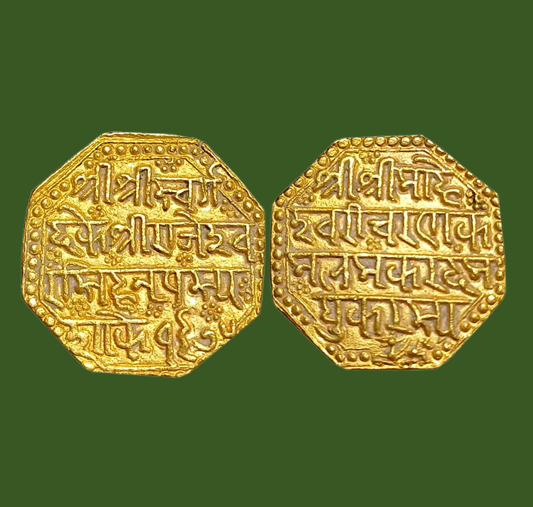
He issued coins (silver rupees and gold mohurs) with legends in Assamese, Devanagari, and sometimes Persian, reflecting cultural influences. The above exceptionally rare octagonal gold mohar weighing 11.33g is minted with Devanagari legend and shaka date SE 1675. The obverse Devanagari legend within dotted border reads “Shri Shri Swarga / Deva Sri Rajeshwa/ ra Simha Nrpasya / Sake 1675” in four lines with flower sprays at places in the field. The legend in the reverse reads “Shri Shri Mahe /shwari Charana Ka /mala Makaranda Ma / dhukarasya” in four lines with flower sprays in the field, a winged lion to left below and dotted border around.
-
The Elephant on an Indo-Greek Silver Drachm of Apollodotus I
2026-09-22 TueElephants were not just an important part of Indian heritage and religious traditions; they also ...
-
Gajalakshmi Flanked by Elephants on a Post-Mauryan Ujjaini Copper Coin
2026-09-22 TueThe association between Gajalakshmi and elephants is one of the most enduring motifs in Indian re...
-
Elephant Head on a Bronze Coin of Indo-Scythian King Maues
2026-09-21 MonAs the eighth day of Ganesh Utsav is celebrated, the elephant once again provides a fascinating l...
-
A Remarkable Elephant-and-Lion Standard on Vrishni Coinage
2026-09-21 MonAs Ganesh Utsav continues, the elephant once again offers a fascinating doorway into India’s an...
-
Elephant and Lion on a Cooch Behar Royal Coin
2026-09-19 SatThe elephant occupies a distinctive place in the cultural traditions of eastern India, particular...