
Greek And Roman Deities On Coins-33
2026-02-20 Fri
Ancient Phoenicia was a region along the eastern coast of the Mediterranean, corresponding to present-day Lebanon and parts of modern Syria and Israel. It emerged as a powerful FORCE in the ancient Mediterranean world. Its strategic location along important trade routes allowed the Phoenicians to become noted merchants, Traders, and colonizers during the 1st millennium BCE. Tyre, one of the main cities in Phoenicia, is in present-day Lebanon. The residents honored Melqart as their patron god. His name means 'King of the city,' and he is recognized as the 'LORD of Tyre.'Melqart was a significant god in the Phoenician religion. He was linked to strength and heroism and represented the cycles of Death and rebirth. His influence spread across the Mediterranean, especially in the colonies of Carthage and Gadir. The Greeks and Romans identified him with heracles/Hercules, naming him the Tyrian Hercules.
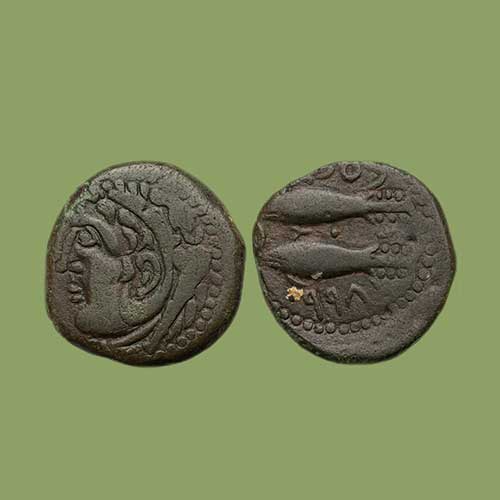
Images of Melqart started to appear on coins around the 5th century BCE. The coin shown in this post is a Bronze Coin from Gadir dated between 400 BCE and 300 BCE. With a weight of 7.26 grams, the obverse features the head of Melqart adorned with a LION Skin, facing left and a club resting on his shoulder. The reverse displays two tuna fish facing left accompanied by Phoenician letters.
Gadir, now known as Cadiz, is a city in Spain founded by the Phoenicians from Tyre as a trading post. It is considered one of the oldest continuously inhabited cities in Western Europe. Historical #records from the 1st century BCE to the 5th century CE mention a temple dedicated to Melqart in Cadiz. Furthermore, archaeological findings indicate that fishing activities have existed in the city since the 8th century BCE, alongside evidence of a well-organized fish-processing Industry that thrived in the 6th to 5th century BCE.
Latest News
-
The Elephant on an Indo-Greek Silver Drachm of Apollodotus I
2026-09-22 TueElephants were not just an important part of Indian heritage and religious traditions; they also ...
-
Gajalakshmi Flanked by Elephants on a Post-Mauryan Ujjaini Copper Coin
2026-09-22 TueThe association between Gajalakshmi and elephants is one of the most enduring motifs in Indian re...
-
Elephant Head on a Bronze Coin of Indo-Scythian King Maues
2026-09-21 MonAs the eighth day of Ganesh Utsav is celebrated, the elephant once again provides a fascinating l...
-
A Remarkable Elephant-and-Lion Standard on Vrishni Coinage
2026-09-21 MonAs Ganesh Utsav continues, the elephant once again offers a fascinating doorway into India’s an...
-
Elephant and Lion on a Cooch Behar Royal Coin
2026-09-19 SatThe elephant occupies a distinctive place in the cultural traditions of eastern India, particular...