
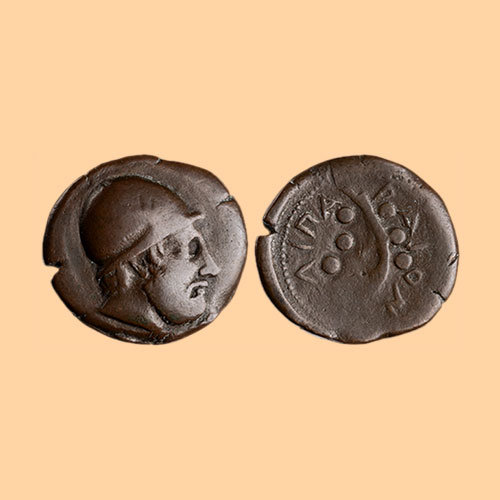
Greek And Roman Deities On Coins-25
2026-02-10 Tue
In #ancient #Greek religion, the twelve Olympians are the main deities of the Greek pantheon, including Hephaestus. Hephaestus, also known as Hephaistos, is honored as the Greek god of artisans, blacksmiths, carpenters, craftsmen, #fire, metallurgy, metalworking, #sculpture, and volcanoes. He is recognized as the master blacksmith of the Olympian gods, creating impressive structures, #armor, and clever devices for them. Notably, he is the only deformed god among the otherwise flawless Olympians. In #Roman tradition, he is linked to Vulcan.According to various #Legends, Hephaestus is either the child of both #Zeus and #Hera or solely of Hera. In both versions, Hera was upset by Hephaestus' appearance and threw him from #mount Olympus down to #Earth. He landed on the #Island of Lemnos, in the northern Aegean Sea, where he suffered permanent injuries. Taken care of by sea nymph Thetis, Hephaestus built his #workshop inside the island's volcano, living in an unbreakable #Bronze #House where he made remarkable metalwork. Eventually, Hephaestus sought #revenge on Hera for her rejection by creating a #magical throne that pinned her in place when she sat down. Although the other gods begged him to return to Mount Olympus to free her, he initially refused. In the end, Dionysus convinced him to go back, and Hephaestus agreed to release Hera after being promised #marriage to #Aphrodite.
In Greek art, Hephaestus is often shown as a #bearded man holding a hammer and tongs. He typically wears a pilos, a protective cap worn by smiths, and a chiton, a tunic common in ancient #Greece and #Rome. His #Image first appeared on coins in the 4th century BCE. The #COIN featured in this post is a Bronze coin from Lipara, dating between 350 BCE and 309 BCE. Lipara is an ancient Greek city-state and island off the northern coast of Sicily in Southern #Italy. With a dia of 39 mm and a weight of 40.66 grams, the obverse features a head of Hephaestus facing right, adorned with a pilos. The reverse displays an aphlaston, the upward-curving stern of an ancient warship, flanked by three pellets on each side, along with the Greek inscription ‘LIPARAION,’ which means ‘Lipara.’
Latest News
-
Mithuna (Couple) Type Coin from the Post-Mauryan Ujjaini Region
2026-11-17 TueContinuing our exploration of the distinctive coinage of the Post-Mauryan Ujjaini region, let us ...
-
Lord Shiva Standing Type Copper Coin of the Ujjaini Region from Post-Mauryan Period
2026-11-17 TueThe Post-Mauryan period (200 BCE–300 CE) witnessed the emergence of several regional kingdoms, ...
-
Rare Silver 1½ Shana Punch-Marked Coin of Panchala Janapada
2026-11-16 MonThe Panchala Janapada was one of the sixteen Mahajanapadas of ancient India, flourishing during t...
-
Earth God on Panchala Copper Coin of King Bhumimitra
2026-11-16 MonThe ancient kingdom of Panchala was one of the prominent Mahajanapadas of northern India. Located...
-
Silver Punch-Marked Coin of Vidarbha Janapada – Melghat Region
2026-11-13 FriThe emergence of Janapadas during the ancient period marked an important phase in India's politic...