
Greek And Roman Deities On Coins-19
2026-02-03 Tue
In ancient Greek religion, Persephone is known as the queen of the underworld. Also called Kore, she represents both the goddess of the dead and the goddess of grain and spring. Persephone is the daughter of Zeus and Demeter. She became the queen of the underworld after Hades, her uncle and the king of the underworld, abducted her and made her his wife. She is honored alongside her mother, Demeter, in the Eleusinian Mysteries, a sacred religious rite in ancient Greece that offered initiates a chance for a blessed afterlife. For more information about Demeter, please visit the following link:Greek And Roman Deities On Coins-18Persephone appears in many forms of Greek art and literature. In one famous story, Hades fell in love with Persephone while she was picking flowers in a meadow. He took her away in his chariot to live with him in the underworld. Heartbroken by her daughter's disappearance, Demeter searched the Earth for Persephone. When she learned that Zeus allowed the abduction, Demeter became furious and refused to let the Earth produce food until her daughter returned. The resulting drought caused great suffering among mortals, prompting Zeus to agree to Persephone's release. However, because Persephone had eaten some food from Hades, specifically a few pomegranate seeds, she had to spend part of each year with her husband in the underworld. Her return to the Earth in spring symbolizes the blooming of meadows and the renewal of crops, while her descent into the underworld during winter marks the end of plant growth and the fading of life. This story is often seen as a metaphor for the changing seasons.
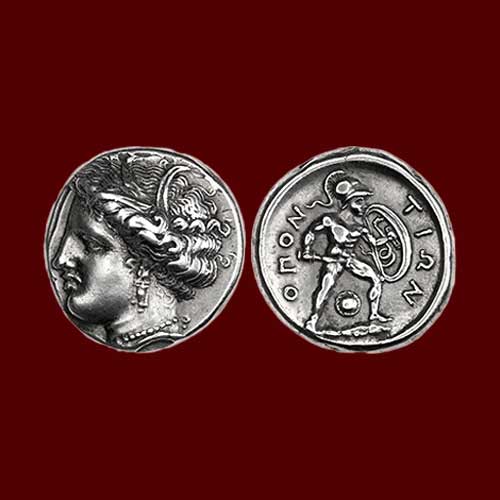
In Greek art, Persephone is usually shown in elegant robes and often alongside Demeter. Both goddesses are commonly illustrated wearing crowns and holding symbols like a torch, scepter, or stalks of grain. Her image has appeared on coins since the 4th century BCE. The coin featured here is a Silver Stater from Opus, an ancient Greek city, minted between 380 and 360 BCE. Opus served as the principal city of the Locri tribe, a region known as Locri Opuntii. This particular coin weighs 12.13 grams; the obverse features the head of Persephone facing left, while the reverse depicts Ajax the Lesser, who is portrayed nude except for a crested Corinthian helmet. He is shown advancing to the right while holding a sword in his right hand and a shield adorned with a coiled serpent on his left arm. Additionally, a spear is displayed below Ajax, and there is a Greek inscription ‘OPONTION,’ meaning ‘of the Opuntians.’
Ajax the Lesser is recognized as a distinguished Greek hero from the Trojan War, noted for being the son of King Oileus of Locris and the commander of the Locrian fleet.
Latest News
-
The Elephant on an Indo-Greek Silver Drachm of Apollodotus I
2026-09-22 TueElephants were not just an important part of Indian heritage and religious traditions; they also ...
-
Gajalakshmi Flanked by Elephants on a Post-Mauryan Ujjaini Copper Coin
2026-09-22 TueThe association between Gajalakshmi and elephants is one of the most enduring motifs in Indian re...
-
Elephant Head on a Bronze Coin of Indo-Scythian King Maues
2026-09-21 MonAs the eighth day of Ganesh Utsav is celebrated, the elephant once again provides a fascinating l...
-
A Remarkable Elephant-and-Lion Standard on Vrishni Coinage
2026-09-21 MonAs Ganesh Utsav continues, the elephant once again offers a fascinating doorway into India’s an...
-
Elephant and Lion on a Cooch Behar Royal Coin
2026-09-19 SatThe elephant occupies a distinctive place in the cultural traditions of eastern India, particular...