
Greek And Roman Deities On Coins-13
2026-01-23 Fri
In ancient #Greek religion, Helios is a god personified as a Sun. He is the offspring of the #titans (deities that preceded the Olympians) Hyperion and Theia and is renowned for his daily journey across the sky in a golden chariot, moving from east to #WEST. In addition to his #Solar associations, Helios serves as the guardian of oaths and is linked to the #Concept of sight. In Roman #tradition, he is referred to as Sol.In ancient times, Helios was venerated in various locations throughout #Greece, with his most significant #cult centers situated on the #Island of Rhodes. There, the Colossus of Rhodes, a monumental statue of Helios, once graced the port until it was destroyed by an #earthquake.
In Greek art, Helios is frequently depicted adorned with a radiant #Crown and driving a horse-drawn chariot across the sky. He is typically portrayed as a youthful figure without a beard, wearing a chiton (a tunic worn by people from ancient Greece and #Rome), while holding a whip and guiding his quadriga, often accompanied by other celestial deities.
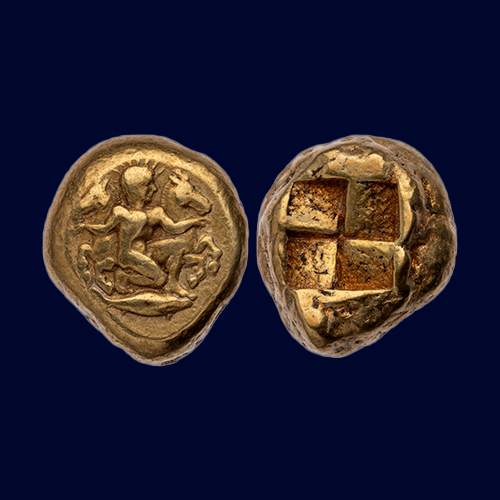
Images of Helios began to appear on coins during the 5th century BCE. The coin featured on this post is a 475 BCE Electrum Stater from Cyzicus or Kyzikos, an ancient Greek town located in Mysia, present-day #Turkey. To learn more about Cyzicus, refer to the link below:
Greek And Roman Deities On Coins-2
Measuring 17mm in dia and weighing 16.01 grams, the obverse of the coin features Helios kneeling to the right, flanked by two #Horses, with a tuna fish depicted below him. The reverse showcases a swastika pattern, or a quadripartite incuse square.
Latest News
-
Greek And Roman Deities On Coins-12
2026-01-22 ThuHermes is recognized as an Olympian deity in #ancient #Greek religion and is traditionally regarded...
-
Greek And Roman Deities On Coins-11
2026-01-22 ThuThe #Greek god Pan is a distinctive figure within the extensive and varied #Pantheon of Greek tradit...
-
A Gold Gadyana (3.78g) of Barma Bhupala of Torgale, a feudatory region under the Kalachuris of Kalyani, sold for INR 5,50,000
2026-01-21 WedGold Gadyana (3.78g) of Barma Bhupala, a powerful feudatory ruler of the Torgale region (located in ...
-
Greek And Roman Deities On Coins-10
2026-01-20 TueAphrodite, one of the most worshipped deities in ancient Greece, stands as the goddess of love, desi...
-
Greek And Roman Deities On Coins-9
2026-01-19 MonThe Greek goddess Nike holds a significant place in the ancient Greek world as a deity associated wi...