
Science and Technology on Indian Postage Stamps-30
2026-01-07 Wed
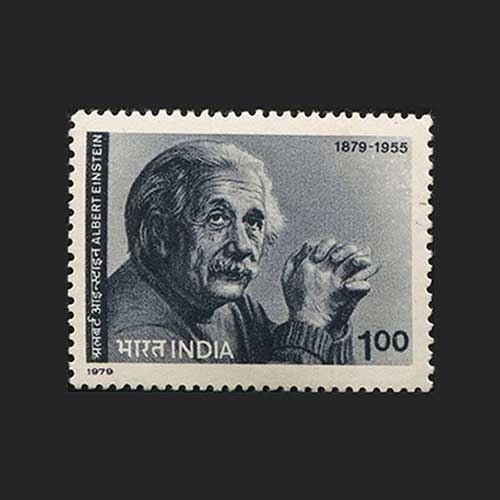
Albert Einstein, a world renowned theoretical physicist, fundamentally transformed the landscape of Science with his Theory of Relativity, his mass-energy equivalence equation (E=mc²), and his extensive contributions to quantum theory. He was recognized as a prodigy during his early twenties. In 1921, he was awarded the Nobel Prize in Physics, solidifying his status as the most influential physicist of the 20th century.Einstein was born on 14 March 1879, in Ulm, Württemberg, Germany. In his early years, his parents expressed concern regarding his learning pace, particularly his delayed speech development. However, at the age of five, a gift from his father—a compass, fostered a profound fascination with the natural world, marking the beginning of his scientific journey.
In 1894, following his family's relocation to Italy for improved career opportunities, a young Einstein chose to remain in Germany to complete his Education. His dissatisfaction with the Local schooling system, which emphasized rote memorization over critical thinking, led him to leave school in 1894 and join his family in Italy. He later pursued his studies at Aarau, Switzerland, and subsequently enrolled at the Swiss Federal Polytechnic School in Zurich in 1896, with the intent to become a teacher in physics and Mathematics.
Upon graduating in 1901, Einstein acquired Swiss citizenship. Faced with challenges in securing a teaching position, he accepted a role as a technical assistant at the Swiss Patent Office. Between 1902 and 1909, he continued to work at a patent office in Bern, Switzerland, and earned his PhD from the University of Zurich in 1905. During this period, he published numerous influential papers in theoretical physics.
His publication of the general theory of relativity in 1916 marked a significant milestone, as it established a relationship between gravitation, acceleration, and four-dimensional space-time, effectively explaining variations in planetary orbital motions. In 1921, he received the Nobel Prize for Physics for his groundbreaking work on the photoelectric effect, which introduced the concept of light as being composed of particles known as photons. Einstein's work suggested that a photon's energy is directly proportional to the frequency of the radiation it emits.
In 1933, Einstein emigrated to the United States to assume the position of Professor of Theoretical Physics at Princeton University, acquiring U.S. citizenship in 1940. Notably, in 1939, he wrote a letter to former President of USA Roosevelt advocating for the development of Atomic Weapons, driven by a sense of moral obligation amidst the rising threat of fascism—a decision he later expressed regret over due to its consequences.
Albert Einstein passed away on 18 April 1955, succumbing to an abdominal internal bleeding, which he refused to have treated. In recognition of his legacy, India Post honoured Einstein’s #birth centenary with a commemorative stamp on 14 March 1979.
Moreover, Einstein maintained connections with prominent figures such as Satyendranath Bose, Rabindranath Tagore, Mahatma Gandhi, and Jawaharlal Nehru. While he demonstrated an interest in Indian Philosophy, he also made remarks that reflected xenophobic attitudes toward Indians.
Latest News
-
Malwa Sultan Mahmud Shah II's Silver Tanka
2026-01-07 WedMahmud Shah II was the last ruler of the #Khalji dynasty of the #Malwa #Sultanate, reigning from AH ...
-
Greek And Roman Deities On Coins-1
2026-01-07 WedCoins were introduced in Greece and India almost simultaneously. Lydian Lion coins are considered as...
-
Science and Technology on Indian Postage Stamps-29
2026-01-05 MonHomeopathy is a widely recognized system of Medicine that continues to attract patients seeking reli...
-
Science and Technology on Indian Postage Stamps-28
2026-01-05 MonBerliner Gramophone was an American record label, recognized as the first and, for nearly a decade, ...
-
Science and Technology on Indian Postage Stamps-27
2026-01-03 SatAlexander Graham Bell, a Scottish-born scientist and Engineer, is widely recognized for patenting th...