
Fascinating Archaeological Facts on Postage Stamps - 76
2025-07-23 Wed
Wheat is recognized as one of the most significant cereal crops globally. This crop has undergone a transformation through both natural Evolution and human intervention, evolving from its primitive form, Einkorn wheat, into prominent cultivated varieties such as bread wheat (T. aestivum L.) and durum wheat (T. turgidum L. var. durum). In India, wheat holds a distinguished position as the second most important Food crop in terms of both cultivated area and Production, particularly thriving in the Northwestern states where the vast indo-Gangetic plains provide an optimal climate for its growth. A study conducted by the Indian council of Agricultural research (ICAR) - Indian Institute of Wheat & barley Research in 2018 identified a total of 448 wheat varieties that have been officially recognized for cultivation across various agro-ecological regions of India.According to Arzani and Ashraf (2017), wheat is among the earliest species to have been domesticated, nearly 10000 years ago during the Neolithic period in the Fertile Crescent. This region, located in the MiddleEast, spans from Jordan, Palestine, and Lebanon to Syria, Turkey, Iraq, and Iran, where the wild ancestors of wheat continue to be found.
The historical significance of wheat in the Indian subcontinent is supported by both archaeological and literary evidence. Liu et al. in their publication, "The Virtues of Small Grain Size: Potential Pathways to a Distinguishing Feature of Asian Wheats" (2016), assert that wheat species were already documented in western South Asia around 5000 BCE at Mehgarh, a Neolithic archaeological site in Balochistan, #Pakistan. The cultivation of wheat gradually extended further east and south into the Indus region during the third millennium BCE and subsequently into the Ganges valley and southern India.
Notably, Indian shot wheat or dwarf wheat (T. sphaerococcum) is endemic to southern Pakistan and northwestern India. Archaeological findings from Mohenjo-Daro indicate that this particular variety was cultivated as early as 3000 BCE.
Wheat is also cited in ancient literary texts, where traditional food items prepared from wheat were prevalent, as referenced in the Rigveda, Atharvaveda, and Jatakas. Patil and Ahirrao, in their work "Origin and History of Godhuma (Wheat): An Indian Perspective" (2022), highlight that while wheat was established in ancient times, it faced challenges in acceptance, being described as an inferior grain in the Charaka Samhita and Susruta Samhita.
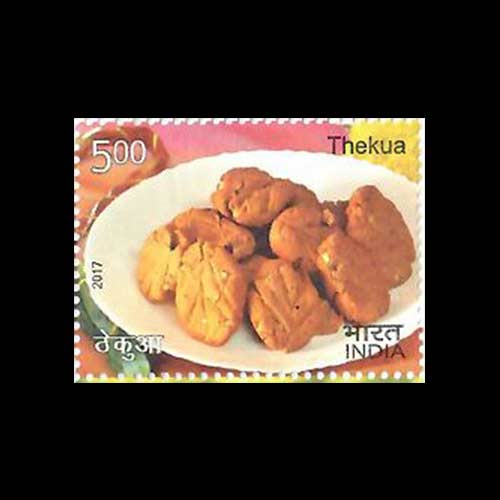
On 03 November 2017, India post issued a Set of 24 stamps along with 5 miniature sheets on Indian Cuisine. Six of these stamps feature Dishes where wheat is the main ingredient, including Malpua, Gujhiya, Thekua, bhature, Bati and Litti.
Latest News
-
The Elephant on an Indo-Greek Silver Drachm of Apollodotus I
2026-09-22 TueElephants were not just an important part of Indian heritage and religious traditions; they also ...
-
Gajalakshmi Flanked by Elephants on a Post-Mauryan Ujjaini Copper Coin
2026-09-22 TueThe association between Gajalakshmi and elephants is one of the most enduring motifs in Indian re...
-
Elephant Head on a Bronze Coin of Indo-Scythian King Maues
2026-09-21 MonAs the eighth day of Ganesh Utsav is celebrated, the elephant once again provides a fascinating l...
-
A Remarkable Elephant-and-Lion Standard on Vrishni Coinage
2026-09-21 MonAs Ganesh Utsav continues, the elephant once again offers a fascinating doorway into India’s an...
-
Elephant and Lion on a Cooch Behar Royal Coin
2026-09-19 SatThe elephant occupies a distinctive place in the cultural traditions of eastern India, particular...