
Fascinating Archaeological Facts on Postage Stamps - 72
2025-07-14 Mon
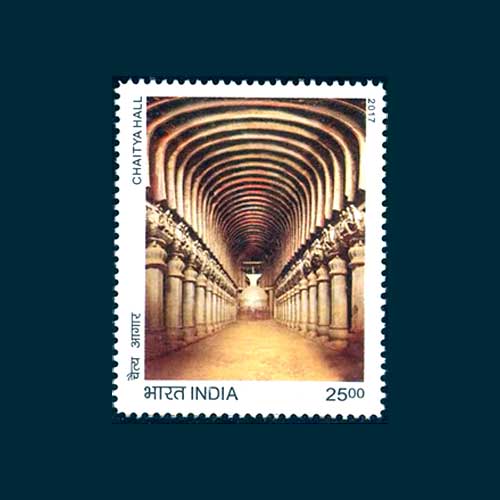
The Karle Caves, situated in Karli, Maharashtra, represent a significant ancient Buddhist rock-cut caves complex, developed between the 2nd century BCE and the 5th century CE. This site comprises 16 rock-cut caves and is best known for the Grand Chaitya carved in one of its caves.Designated as Cave No. 8, this chaitya hall is recognized as the largest among western India's rock-cut cave complexes. Its construction was made possible through the generous Donations of various individuals, each contributing to different elements such as railings, sculptures, or pillars. The initiative was spearheaded by a merchant named Bhutapala from Vaijayanti, which is present-day Banvasi in Karnataka.
According to Dandekar, Ganvir and Joge in 'An Unpublished Inscription from the Karle Chaitya Cave (2017)', a significant portion of these donations originated from residents of a town referred to as ‘Dhenuk?ka?a.’ Approximately 17 inscriptions Document the name Dhenuk?ka?a; however, there remains an ongoing scholarly #debate regarding its precise identification and current #location. Notably, some scholars, including Bhandarkar, associate Dhenuk?ka?a with Dharanikota in Andhra Pradesh, while historian H.S. Thosar opines that it corresponds to Junnar in Maharashtra.
The inscriptions located at the site suggest strong ties to the Mahasamghika monastic order, an early Buddhist school that emerged from the first schism within the Buddhist Sangha. The chaitya hall's construction is attributed to the era of Western Kshatrapa rule in the western Deccan, particularly during the reign of Nahapana.
Additionally, this site received patronage from the Satavahana ruler Pulumavi in the mid-second century CE. The caves were further supported by offerings from a diverse array of individuals, including Traders , monks, nuns, pilgrims, and guilds from both nearby and distant TOWNS.
The Karle chaitya is carved into the mountainside, extending 124 feet into the rock and featuring a barrel-vaulted roof that reaches a height of 46 feet. The apsidal cave two narrow aisles, divided on either side by a series of fifteen octagonal pillars. These pillars rise from pot-shaped bases and bear capitals depicting couples or individuals riding on elephants and Horses, along with inscriptions that chronicle the details of donations and #gifts. The stupa is situated at the far end of the apsidal protrusion, accompanied by seven octagonal shafts both behind and to the sides. Remarkably, the yasti-chattra (parasol) atop the stupa is crafted from wood and remains intact. The site notably employed considerable wooden elements in its architecture, as evidenced by the remnants of wooden ribs found in the barrel-vaulted roof.
On 01 January 2017, India Post issued a Set of 12 Stamps and a se-tenant block titled 'Splendours of India.' One of these stamps specifically features the Chaitya Hall from Karle, with a designated face value of Rs. 25.
Latest News
-
The Elephant on an Indo-Greek Silver Drachm of Apollodotus I
2026-09-22 TueElephants were not just an important part of Indian heritage and religious traditions; they also ...
-
Gajalakshmi Flanked by Elephants on a Post-Mauryan Ujjaini Copper Coin
2026-09-22 TueThe association between Gajalakshmi and elephants is one of the most enduring motifs in Indian re...
-
Elephant Head on a Bronze Coin of Indo-Scythian King Maues
2026-09-21 MonAs the eighth day of Ganesh Utsav is celebrated, the elephant once again provides a fascinating l...
-
A Remarkable Elephant-and-Lion Standard on Vrishni Coinage
2026-09-21 MonAs Ganesh Utsav continues, the elephant once again offers a fascinating doorway into India’s an...
-
Elephant and Lion on a Cooch Behar Royal Coin
2026-09-19 SatThe elephant occupies a distinctive place in the cultural traditions of eastern India, particular...