
Fascinating Archaeological Facts on Postage Stamps - 53
2025-06-25 Wed
India possesses a Rich and longstanding tradition of Maritime Heritage, as evidenced by references found in ancient Scriptures such as the Vedas, Ramayana, Mahabharata, etc. Notably, the term 'navigation' is derived from the Sanskrit word "navgati," while "catamaran," (a boat with two parallel hulls held by a single deck), originates from the Tamil word "kattumaram."The earliest material evidence of seafaring in India is linked to the Harappan Civilization, recognized as one of the first seafaring cultures in the recorded History of the Indian subcontinent. The Harappans actively engaged in maritime trade with distant civilizations, and archaeological findings provide significant insight into their vibrant maritime activities. For instance, the excavation of the port city of Lothal by S.R. Rao in Gujarat revealed a sophisticated dockyard dating back to approximately 2400 BCE. This facility functioned as a crucial center of maritime trade, facilitating connections between India and regions such as Mesopotamia and Egypt, among others, along ancient trade routes. Additionally, five terracotta models of boats were uncovered in this excavation.
In 1964-65, during the excavations at Mohenjodaro, G.F. Dales discovered a potsherd adorned with a motif of a boat, illustrating a mast and a furled sail.
No remains of actual boats have been found in the excavations of Harappan sites. The shape and other details of the boats used can only be inferred from clay models of boats, paintings on potsherds, and seals.
Furthermore, the excavation at Mohenjodaro conducted by G.F. Dales revealed an amulet depicting a Harappan boat featuring two steering oars. The design includes a cabin positioned centrally, with crow-like birds, referred to as disakakas, placed at both ends. These birds were employed by sailors to locate land. Two masts were also observed on either side of the central cabin.
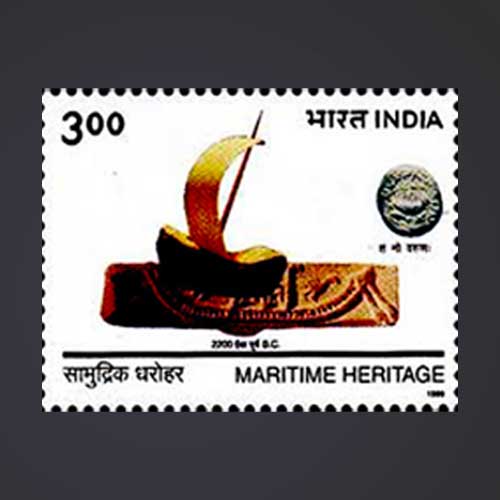
On April 5, 1999, India Post commemorated the Maritime Heritage of India by issuing a set of two stamps. One stamp features the previously mentioned terracotta amulet from Mohenjodaro, along with a boat model from Lothal, a coin illustrating a boat, and the motto of Indian Navy -"Sham No Varunah" (?? ?? ????:), which translates to "May the #Lord of Oceans – Varuna be auspicious unto us."
The Rig Veda acknowledges Varuna, the Lord of the Ocean, recognizing him as the custodian of knowledge concerning ocean routes utilized by ships. He is venerated as the presiding deity of waters and plays a vital role in maintaining cosmic order.
Latest News
-
Mithuna (Couple) Type Coin from the Post-Mauryan Ujjaini Region
2026-11-17 TueContinuing our exploration of the distinctive coinage of the Post-Mauryan Ujjaini region, let us ...
-
Lord Shiva Standing Type Copper Coin of the Ujjaini Region from Post-Mauryan Period
2026-11-17 TueThe Post-Mauryan period (200 BCE–300 CE) witnessed the emergence of several regional kingdoms, ...
-
Rare Silver 1½ Shana Punch-Marked Coin of Panchala Janapada
2026-11-16 MonThe Panchala Janapada was one of the sixteen Mahajanapadas of ancient India, flourishing during t...
-
Earth God on Panchala Copper Coin of King Bhumimitra
2026-11-16 MonThe ancient kingdom of Panchala was one of the prominent Mahajanapadas of northern India. Located...
-
Silver Punch-Marked Coin of Vidarbha Janapada – Melghat Region
2026-11-13 FriThe emergence of Janapadas during the ancient period marked an important phase in India's politic...