
William I of the Netherlands
2021-08-17 Tue
William-I was a Prince of Orange, the King of the Netherlands, and Grand Duke of Luxembourg. He sparked a commercial and industrial revival following the period of French rule (1795–1813) but provoked the Belgian revolt of 1830 through his autocratic methods.He was the son of the last Stadtholder of the Dutch Republic. After an agreement with Napoleon, he became the ruler of the Principality of Nassau-Orange-Fulda from 1803 until 1806, when he was deposed by Napoleon. In November 1813, after the defeat of Napoleon at the Battle of Leipzig, he was asked to become the Sovereign Prince of the United Netherlands. He proclaimed himself King of the Netherlands on 16 March 1815. On 9 June of the same year, William I also became the Grand Duke of Luxembourg and in 1839 he became the Duke of Limburg. After his abdication in 1840, he styled himself King William Frederick, Count of Nassau.
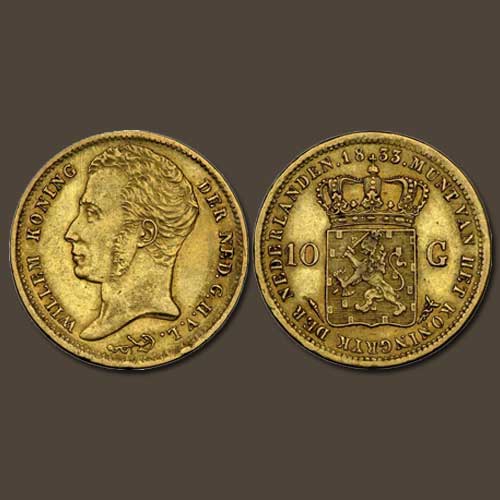
Here is an image of 10 Gulden Coin issued under his reign. The obverse of a coin depicts his portrait. The reverse of a coin represents Face value, year of issue, Coat of arms, and Country-designation.
Image Source: https://www.coinshome.net/
Latest News
-
Elephant and Lion on a Copper Coin of the Sangam Cholas
2026-09-24 ThuThe elephant and lion were powerful animal symbols in the artistic and political traditions of an...
-
Ganesha and Shiva Together on a Coin of the Shiv Ganga Rajas
2026-09-25 FriOn Anant Chaturdashi, devotees bid farewell to Lord Ganesha with prayers and devotion, celebratin...
-
Elephant on a Punch-Marked Coin of the Vidarbha Janapada
2026-09-23 WedThe history of Indian coinage begins with the remarkable tradition of punch-marked coins, among t...
-
Gandabherunda and Four Elephants on a Gold Half Varaha of Achyutadevaraya
2026-09-23 WedThe Gandabherunda, the mythical two-headed bird of Indian tradition, is one of the most striking ...
-
The Elephant on an Indo-Greek Silver Drachm of Apollodotus I
2026-09-22 TueElephants were not just an important part of Indian heritage and religious traditions; they also ...