
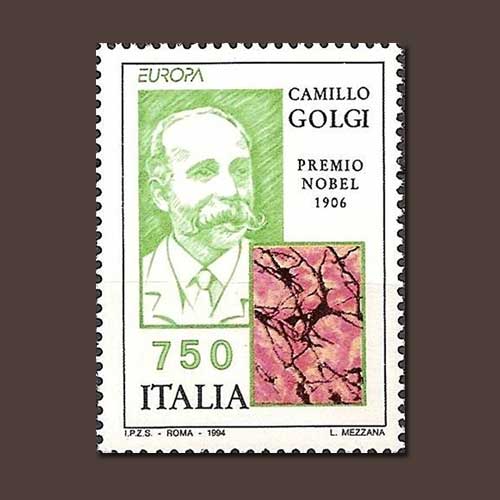
Birth Anniversary of Camilo Golgi
2021-07-07 Wed
Camilo Golgi was an Italian biologist and pathologist known for his works on the central nervous system. He studied medicine at the University of Pavia (where he later spent most of his professional career) between 1860 and 1868 under the tutelage of Cesare Lombroso. Inspired by pathologist Giulio Bizzozero, he pursued research in the nervous system.His discovery of a staining technique called black reaction (sometimes called Golgi's method or Golgi's staining in his honour) in 1873 was a major breakthrough in neuroscience. Several structures and phenomena in anatomy and physiology are named for him, including the Golgi apparatus, the Golgi tendon organ and the Golgi tendon reflex.
Golgi and the Spanish biologist Santiago Ramon y Cajal were jointly given the Nobel Prize in Physiology or Medicine 1906 "in recognition of their work on the structure of the nervous system".
He received honorary doctorates from the University of Cambridge, University of Geneva, Kristiania University College, National and Kapodistrian University of Athens, and Paris-Sorbonne University. In 1994, the European Community commemorated him with postage stamps.
Image Source: Wikipedia.org
Latest News
-
Elephant and Lion on a Copper Coin of the Sangam Cholas
2026-09-24 ThuThe elephant and lion were powerful animal symbols in the artistic and political traditions of an...
-
Ganesha and Shiva Together on a Coin of the Shiv Ganga Rajas
2026-09-25 FriOn Anant Chaturdashi, devotees bid farewell to Lord Ganesha with prayers and devotion, celebratin...
-
Elephant on a Punch-Marked Coin of the Vidarbha Janapada
2026-09-23 WedThe history of Indian coinage begins with the remarkable tradition of punch-marked coins, among t...
-
Gandabherunda and Four Elephants on a Gold Half Varaha of Achyutadevaraya
2026-09-23 WedThe Gandabherunda, the mythical two-headed bird of Indian tradition, is one of the most striking ...
-
The Elephant on an Indo-Greek Silver Drachm of Apollodotus I
2026-09-22 TueElephants were not just an important part of Indian heritage and religious traditions; they also ...