
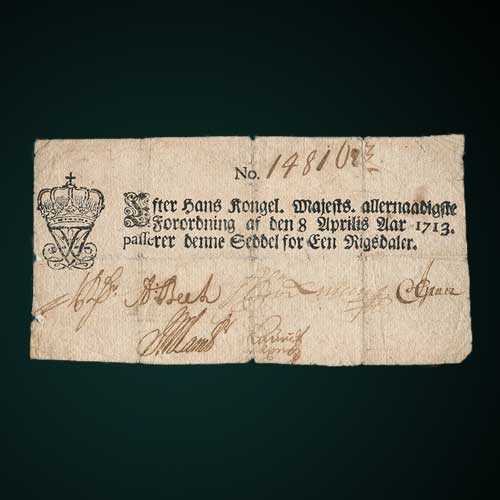
First Danish Bank Note
2021-06-01 Tue
Dating back to 1713, the one ‘rigsdaler’ note was issued when King Frederick IV issued Denmark’s first paper money to replenish the Royal coffers due to the expenses of the Great Northern War. The Danish currency system established in 1625 consisted of penning, skilling, mark, rigsdaler, and krone. In 1713, the government introduced notes for 1, 2, and 3 marks, 1, 5, 10, 25, 50, and 100 rigsdalers.In addition to being exceptionally rare, the banknote is also of great monetary historical significance. It is the beginning of the currency history of the country. It was the first time in Denmark that money no longer needed to be silver or gold, but could also be made of paper.
The 1-rigsdaler note of 1713 has the handwritten serial number 148163, with five signatures and the value both printed and handwritten. The banknote sold for 170,000 kroner, nearly triples the 60,000 kroner to 80,000 kroner guide price.
Image Courtesy: thelocal.dk
Latest News
-
Elephant and Lion on a Copper Coin of the Sangam Cholas
2026-09-24 ThuThe elephant and lion were powerful animal symbols in the artistic and political traditions of an...
-
Ganesha and Shiva Together on a Coin of the Shiv Ganga Rajas
2026-09-25 FriOn Anant Chaturdashi, devotees bid farewell to Lord Ganesha with prayers and devotion, celebratin...
-
Elephant on a Punch-Marked Coin of the Vidarbha Janapada
2026-09-23 WedThe history of Indian coinage begins with the remarkable tradition of punch-marked coins, among t...
-
Gandabherunda and Four Elephants on a Gold Half Varaha of Achyutadevaraya
2026-09-23 WedThe Gandabherunda, the mythical two-headed bird of Indian tradition, is one of the most striking ...
-
The Elephant on an Indo-Greek Silver Drachm of Apollodotus I
2026-09-22 TueElephants were not just an important part of Indian heritage and religious traditions; they also ...