
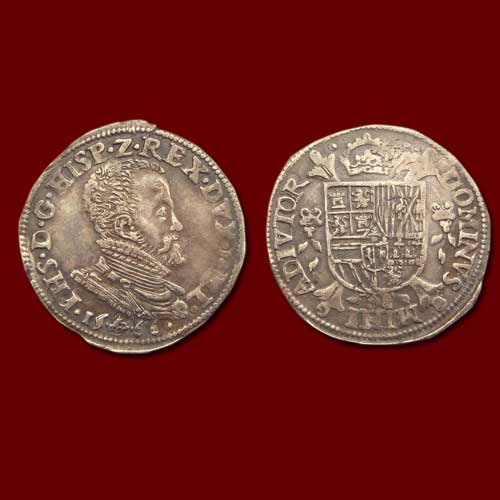
King Philip II of Spain
2021-05-21 Fri
Philip II was king of the Spaniards (1556–98) and king of the Portuguese (as Philip I, 1580–98), champion of the Roman Catholic Counter-Reformation. During his reign, the Spanish empire attained its greatest power, extent, and influence, though he failed to suppress the revolt of the Netherlands (beginning in 1566) and lost the “Invincible Armada” in the attempted invasion of England (1588).The son of Emperor Charles V and Isabella of Portugal, Philip inherited his father's Spanish Empire, including territories on every continent then known to Europeans. The Philippines were named in his honor by Ruy Lopez de Villalobos. During his reign, the Spanish kingdoms reached the height of their influence and power, sometimes called the Spanish Golden Age.
His coinage typically bore the obverse inscription "Philip, by the grace of God King of Spain et cetera", followed by the local title of the mint. The reverse would then bear a motto such as "For Peace and Justice" or "The Lord is my helper".
Portrait of Philip II depicted on 1/5 Philipsdaalder, struck in 1566, Guelders, Low Countries.
Image Source: Wikipedia.org
Latest News
-
Elephant and Lion on a Copper Coin of the Sangam Cholas
2026-09-24 ThuThe elephant and lion were powerful animal symbols in the artistic and political traditions of an...
-
Ganesha and Shiva Together on a Coin of the Shiv Ganga Rajas
2026-09-25 FriOn Anant Chaturdashi, devotees bid farewell to Lord Ganesha with prayers and devotion, celebratin...
-
Elephant on a Punch-Marked Coin of the Vidarbha Janapada
2026-09-23 WedThe history of Indian coinage begins with the remarkable tradition of punch-marked coins, among t...
-
Gandabherunda and Four Elephants on a Gold Half Varaha of Achyutadevaraya
2026-09-23 WedThe Gandabherunda, the mythical two-headed bird of Indian tradition, is one of the most striking ...
-
The Elephant on an Indo-Greek Silver Drachm of Apollodotus I
2026-09-22 TueElephants were not just an important part of Indian heritage and religious traditions; they also ...