
Mexico's Cinco de Mayo
2021-05-05 Wed
Cinco de Mayo is an annual celebration held in the United States and some localities in Mexico on May 5. It commemorates the Battle of Puebla that ended in a Mexican army's unlikely victory over a larger and better-equipped French army.The Battle of Puebla occurred on 5th May 1862 during the French intervention in Mexico. Although the Mexicans were eventually overrun in subsequent battles, victory at Puebla was an inspirational event for the Mexican troops. Some scholars also believe that in the long run French defeat at Puebla influenced the outcome of the American Civil War.
The holiday's name, Cinco de Mayo, is translated from Spanish as “fifth of May”. In Mexico, Cinco de Mayo is referred to as the Battle of Puebla Day. It was first observed in California in response to Mexico's victory in the battle.
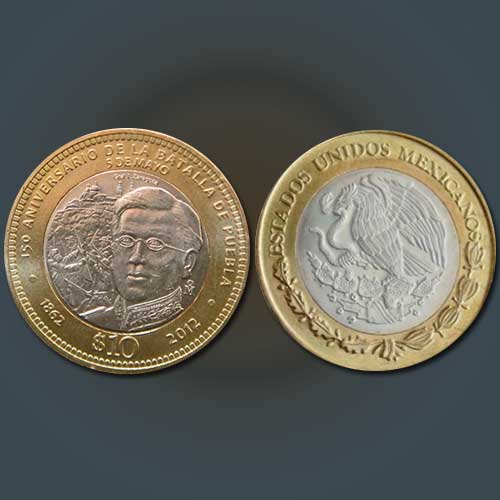
The Bank of Mexico has released a coin bimetallic legal tender with a face value of ten pesos alluding to the 150th Anniversary of the Battle of Puebla within the framework of the solemn commemoration of the 150th death anniversary of General Ignacio Zaragoza, who died in that city.
Image Courtesy: worldofcoins.eu
Latest News
-
Elephant and Lion on a Copper Coin of the Sangam Cholas
2026-09-24 ThuThe elephant and lion were powerful animal symbols in the artistic and political traditions of an...
-
Ganesha and Shiva Together on a Coin of the Shiv Ganga Rajas
2026-09-25 FriOn Anant Chaturdashi, devotees bid farewell to Lord Ganesha with prayers and devotion, celebratin...
-
Elephant on a Punch-Marked Coin of the Vidarbha Janapada
2026-09-23 WedThe history of Indian coinage begins with the remarkable tradition of punch-marked coins, among t...
-
Gandabherunda and Four Elephants on a Gold Half Varaha of Achyutadevaraya
2026-09-23 WedThe Gandabherunda, the mythical two-headed bird of Indian tradition, is one of the most striking ...
-
The Elephant on an Indo-Greek Silver Drachm of Apollodotus I
2026-09-22 TueElephants were not just an important part of Indian heritage and religious traditions; they also ...