
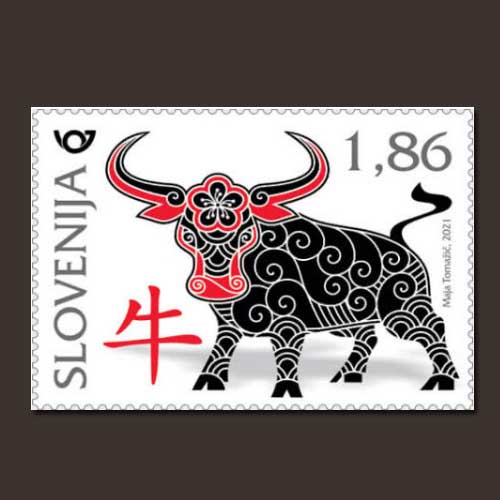
Year of Bull on stamp
2021-02-03 Wed
Slovenia Post introduced a new stamp ‘Year of the Ox’ to attract collector’s attention. This stamp features the image of a solemn ox-drawn in black and red colour. This is the second animal in the Chinese hieroglyph was designed y major Tomazic.2021 is the year of the OX which will begin on February 12, 2021, and last until January 30, 2022. This will be the year of the Metal Bull. The OX embodies external solidarity independence, consistency and the desire for order. He is conservation and pragmatic. Very persistent, stubborn and therefore it succeeds where others fail. People born in Year of the OX have a strong sense of responsibility and justice but also be stubborn and inflexible.
A bull is the traditional Chinese symbol of spring and the exception of a good year, a new beginning, happiness, sudden luck, good news. In China, the calm power of domestic buffalo is associate with a contemplative life according to legend, the sage Lao Tzu lef China riding a buffalo.
To know more about stamp Visit philamart to view and purchase a variety of stamps from all over the world.
Image Courtesy: findyourstampvalue
Latest News
-
Goddess Lakshmi in Padmasana Posture on a Rare Kakatiya Gold Gadyana Coin
2026-11-19 ThuThe Kakatiya dynasty was an important ruling power in the Deccan, with its influence centred arou...
-
Chalukyan-style Temple on Gold Gadyana
2026-11-19 ThuThe Chalukyas of Kalyani, also known as the Western Chalukyas, were an influential ruling dynasty...
-
An Interesting Five-Symbols on Punch-Marked Copper Square Karshapana of Eran
2026-11-18 WedThe ancient region of Eran, situated in present-day Madhya Pradesh, was an important centre of ea...
-
Sacred Symbols and Natural Motifs on Post-Mauryan Coinage of the Eran-Vidisha Region
2026-11-18 WedThe decline of the Mauryan Empire in the second century BCE marked the emergence of several regio...
-
Mithuna (Couple) Type Coin from the Post-Mauryan Ujjaini Region
2026-11-17 TueContinuing our exploration of the distinctive coinage of the Post-Mauryan Ujjaini region, let us ...