
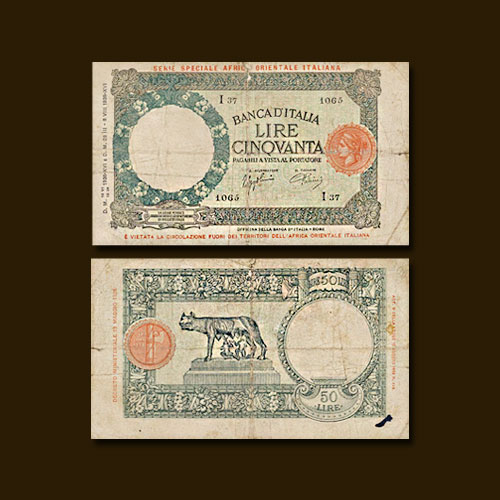
50 Lire Banknote of Italian East Africa
2020-02-14 Fri
The lira AOI was a special banknote circulating in Italian East Africa (Africa Orientale Italiana, or AOI) between 1938 and 1941.In 1936, when Italy was under Fascism, the Italian Colony of Ethiopia was imposed on Italian lira banknotes. Ethiopians were obliged by law to change their coins and banknotes but considering that the thaler was a silver coin with a value 28 times higher than the lira, they began to hide them to retain the metal value.
To stop this illegal practice, the Italian government, in the year 1938, issued a set new banknote namely "lira AOI". In 1938, banknotes were issued for use in Italian East Africa in denominations of 50, 100, 500 and 1000 lire. The lira AOI was immediately replaced by the East African shilling in 1941 when the United Kingdom gained control of Italy's colonies.
The above-shown banknote is 50 Lire banknote issued in the year 1938. The banknote, on the obverse, shows Head of Italia seal at right facing left, a wreath on the left and the name of the bank in the center. The reverse shows the statue of the she-wolf with Romulus and Remus at the center.
Image Courtesy: https://www.realbanknotes.com/
Latest News
-
Goddess Lakshmi in Padmasana Posture on a Rare Kakatiya Gold Gadyana Coin
2026-11-19 ThuThe Kakatiya dynasty was an important ruling power in the Deccan, with its influence centred arou...
-
Chalukyan-style Temple on Gold Gadyana
2026-11-19 ThuThe Chalukyas of Kalyani, also known as the Western Chalukyas, were an influential ruling dynasty...
-
An Interesting Five-Symbols on Punch-Marked Copper Square Karshapana of Eran
2026-11-18 WedThe ancient region of Eran, situated in present-day Madhya Pradesh, was an important centre of ea...
-
Sacred Symbols and Natural Motifs on Post-Mauryan Coinage of the Eran-Vidisha Region
2026-11-18 WedThe decline of the Mauryan Empire in the second century BCE marked the emergence of several regio...
-
Mithuna (Couple) Type Coin from the Post-Mauryan Ujjaini Region
2026-11-17 TueContinuing our exploration of the distinctive coinage of the Post-Mauryan Ujjaini region, let us ...