
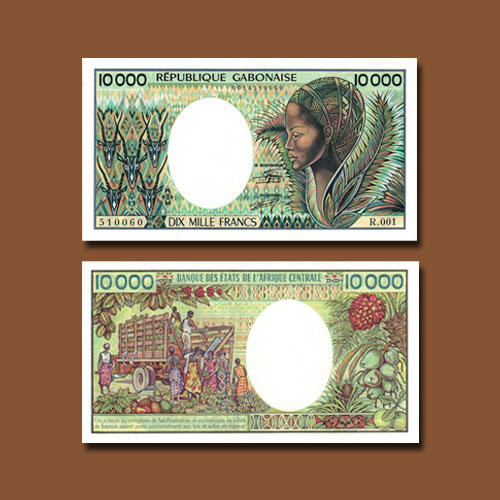
10000 Francs Banknote of Congo of 1984
2020-02-07 Fri
The Republic of the Congo is a country located on the western coast of Central Africa bordered by five countries and the Atlantic Ocean. The region was dominated by Bantu-speaking tribes at least 3,000 years ago, who built trade links leading into the Congo River basin. Congo was formerly part of the French colony of Equatorial Africa.The Republic of the Congo was established on 28 November 1958 but gained independence from France in 1960. Currency denominated in centimes and francs, Congolese frank was first introduced in 1887 for use in the Congo Free State. After the independence of the Democratic Republic of the Congo in 1960, Ruanda-Urundi adopted its own franc, whilst, between 1960 and 1963, Katanga also issued a franc of its own.
The 10,000 francs shown above, was issued in the year 1984. The banknote depicts on the obverse a group of Stylized antelope heads at left along with woman clad in traditional clothes is depicted on the right. On the reverse, the note depicts a loading fruit onto a truck at the left and the local fruits on the right.
Image Courtesy: https://www.ma-shops.com/
Latest News
-
Goddess Lakshmi in Padmasana Posture on a Rare Kakatiya Gold Gadyana Coin
2026-11-19 ThuThe Kakatiya dynasty was an important ruling power in the Deccan, with its influence centred arou...
-
Chalukyan-style Temple on Gold Gadyana
2026-11-19 ThuThe Chalukyas of Kalyani, also known as the Western Chalukyas, were an influential ruling dynasty...
-
An Interesting Five-Symbols on Punch-Marked Copper Square Karshapana of Eran
2026-11-18 WedThe ancient region of Eran, situated in present-day Madhya Pradesh, was an important centre of ea...
-
Sacred Symbols and Natural Motifs on Post-Mauryan Coinage of the Eran-Vidisha Region
2026-11-18 WedThe decline of the Mauryan Empire in the second century BCE marked the emergence of several regio...
-
Mithuna (Couple) Type Coin from the Post-Mauryan Ujjaini Region
2026-11-17 TueContinuing our exploration of the distinctive coinage of the Post-Mauryan Ujjaini region, let us ...