
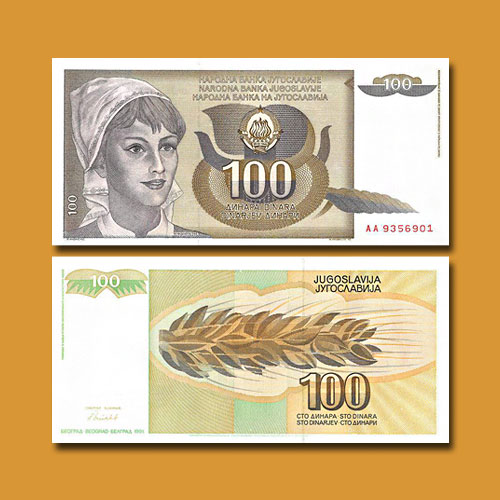
Yugoslavia 100 Dinara banknote of 1991
2020-01-01 Wed
Yugoslavia was a country in Southeastern and Central Europe for most of the 20th century. It came into existence after World War I in 1918. The banknotes of the Yugoslav dinar are the several series of paper money emitted by the central bank of the different consecutive states named Yugoslavia such as the Kingdom of Yugoslavia, Socialist Federal Republic of Yugoslavia and the Federal Republic of Yugoslavia. The dinar was subdivided into 100 paras.In the early 1990s, there was severe and prolonged hyperinflation due to a combination of economic mismanagement and criminality. Massive amounts of money were printed and the highest denomination banknote that was issued was a 500 billion dinars.
Today we are looking at a 100 Dinara banknote that was issued in 1991. The obverse depicts an effigy of a young Yugoslav woman to left and the official Coat of Arms of the country in centre. The reverse features a Wheat ear in the centre. This predominantly Olive-green banknote has the portrait of a young woman as its watermark.
Image Courtesy: Banknote World
Latest News
-
Twin Fishes and Bull on a Pandya Copper Coin
2026-09-28 MonThe Pandyas were one of the three great Tamil dynasties of the Sangam age, alongside the Cheras a...
-
Sangam-Age Chola Copper Coin with Lion/Tiger, Elephant and Auspicious Symbols
2026-09-28 MonThe Cholas were one of the three major Tamil dynasties of the Sangam age, alongside the Cheras an...
-
Elephant and Lion on a Copper Coin of the Sangam Cholas
2026-09-24 ThuThe elephant and lion were powerful animal symbols in the artistic and political traditions of an...
-
Ganesha and Shiva Together on a Coin of the Shiv Ganga Rajas
2026-09-25 FriOn Anant Chaturdashi, devotees bid farewell to Lord Ganesha with prayers and devotion, celebratin...
-
Elephant on a Punch-Marked Coin of the Vidarbha Janapada
2026-09-23 WedThe history of Indian coinage begins with the remarkable tradition of punch-marked coins, among t...