

The Third Battle of Panipat
2017-01-14 Sat
Ahmad Shah Abdali, the Afghan ruler of Durrani taking advantage of the political turbulence in Delhi, wanted to capture the throne, and invaded India four times. Wazir Safdarjung impressed upon the Emperor the need for an agreement with Marathas against Abdali. This agreement signed in 1752 was very important from the Maratha point of view as they now took full responsibility of protecting the Mughal Empire from their internal and external politics; this established Maratha supremacy in the politics of North India.Premise
After the defeat of Dattaji Shinde, a prominent Maratha sardar in the Battle of Barudi Ghat in 1760 against Abdali, a strong army was sent to North under the guidance of Sadashivrao Bhau to defeat Abdali. None of the Hindu chiefs came to help the Marathas while Suja-ud-Daula, Nawab of Awadh joined Abdali. On 2nd August, 1760, Marathas captured Delhi from Yakub Ali Khan, Abdali’s agent. After two months and failed negotiations, Marathas moved towards Kunjpura and captured Abdali’s provisions stored there.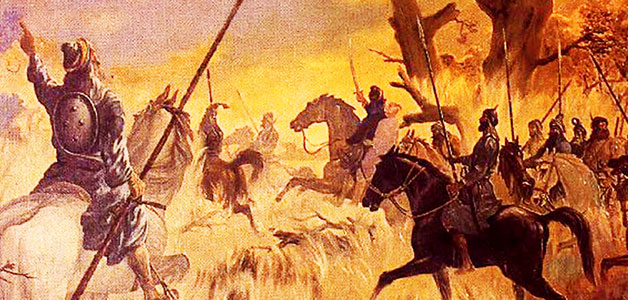
Initial Skirmishes
This angered Abdali and he reached Panipat on 1st November while Bhausaheb had reached there on 29th October. For two months the war was fought on skirmishes on the advice of Ibrahim Khan Gardi; Bhausaheb decided to remain on the defensive.Bhausaheb rearranged his army in a straight line to match Abdali’s force and forge a passage to Deccan as their main objective was now to escape. Bhausaheb with his Huzurat troops took the central position, Antaji Mankeshwar and Santaji Jadhav on right while Yashwantrao Pawar, Jankoji Shinde and Malharrao Holkar went to the extreme ends. No reserved force was left behind.
The Third Battle of Panipat
On 14th Jan, 1761, the Third Battle of Panipat began. In the 1st stage, the Marathas fought vigorously. Ibrahim and Bhausaheb particularly distinguished themselves in the battle. Just when the Maratha soldiers were tired and weak, Abdali threw in his reserved force. This move proved fatal for the Marathas; Bhausaheb, Vishwasrao, Tukoji and Jankoji were killed. Only a small part of the enemy escaped. Abdali won.The defeat at Panipat ended the possibility of the Maratha establishing an all-India empire. Different Maratha chiefs broke away and started ruling over small areas. The battle also gave an opportunity to the English East India Company to consolidate its power in India.
Image courtesy Railyatri.in
Latest News
-
An Elephant depicted on the Copper Thira Cash of Travancore
2026-09-17 Thu -
Two Elephants Flank the Royal Emblem on a Coin of Rama Varma V of Travancore
2026-09-17 Thu -
Elephant Coin of Siri Satakarni, Satavahana
2026-09-16 Wed -
Caparisoned Elephant on Gangas of Talakadu Gold Coin
2026-09-16 Wed -
Rare “Ganapati–Pantapradhan” Rupee of Patwardhans of Miraj
2026-09-15 Tue