
2026-10-06 Tue
The Alupas, also known as the Alupa dynasty, were an important ruling house of the coastal Karnataka region. Their territory, often identified with Alvakheda or Alupakheda, broadly corresponds to parts of present-day Dakshina Kannada and Udupi. The Alupas maintained a long association with the powerful dynasties of South India and played a significant role in the political and cultural history of the western coast.
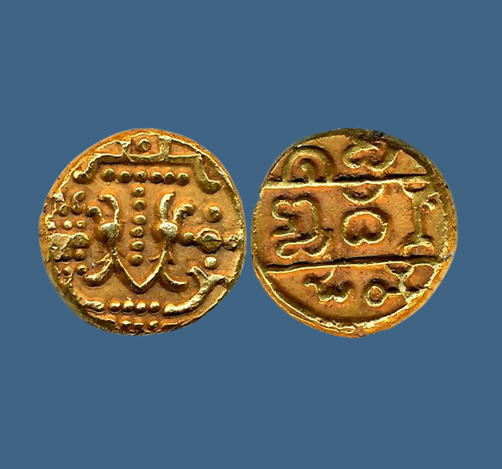
Here, the showcased image is of the Alupas gold Gadyana weighing 3.64 g, issued in the name of “Pandya Dhananjaya.” The coin is particularly noteworthy for its combination of dynastic symbolism, religious motifs and a clearly presented Hale-Kannada legend.
The obverse presents an elaborate composition centred on the dynastic emblem of two vertically arranged fishes, a motif strongly associated with the Pandya tradition. Beneath the fishes is a lotus, while a parasol appears above them. The composition is flanked on both sides by a stylized Shankha (conch) on the left and Chakra (discus) on the right. Both are supported by ornamental floral scrolls, giving the design a distinctly decorative character.
The use of the fish emblem alongside the Shankha and Chakra is especially interesting, reflecting the interaction of dynastic and religious symbolism that is frequently encountered in South Indian coinage. The lotus and parasol further enrich the design, with the latter traditionally associated with sovereignty and royal authority.
The reverse carries a three-line inscription in Hale-Kannada, an early form of Kannada used in inscriptions and coin legends, "Shri Pa / ndya Dhanan / jaya".
The legend reads “Shri Pandya Dhananjaya”, identifying the ruler or royal title associated with the issue. The appearance of the name in Kannada script provides an important regional dimension to the coin, connecting its political identity with the linguistic and cultural milieu of the Alupa kingdom.
-
Elephant and Lion/Tiger on a Rare Copper Coin of the Sangam Cholas
2026-10-06 TueThe Cholas were one of the three great Tamil dynasties of the Sangam age, alongside the Cheras an...
-
With 85 Medals, India marks a Historic Chapter in ASIAD
2026-10-05 MonIndia concluded its campaign at the Aichi-Nagoya Asian Games 2026 with an impressive 85...
-
India’s Kabaddi Golden Double at Asian Games 2026
2026-10-05 MonIndia continued its remarkable dominance in kabaddi at the Asian Games, winning two gol...
-
India’s Shooting Stars at the Asian Games 2026
2026-10-03 SatIndia’s shooters made their mark at the Aichi-Nagoya Asian Games 2026 , bringing home <...
-
Wrestling has been captured on India's Stamps
2026-10-03 SatWrestling has a deep and enduring place in India’s sporting heritage. From the traditional akha...