
Greek And Roman Deities On Coins-9
2026-01-19 Mon
The Greek goddess Nike holds a significant place in the ancient Greek world as a deity associated with victory, both in warfare and in peaceful competitions. While she may be a smaller figure within the broader context of the Greek pantheon, Nike is often depicted alongside prominent gods such as Zeus and Athena in various artistic representations. Her importance in Greek history and religion is profound, and in Roman traditions, she is recognized as Victoria.In the war with the Titans, Zeus sought allies and was joined by Styx (Goddess and a river of the underworld), who introduced him to her four children: Nike (Victory), Zelos (Rivalry), Kratos (Strength), and Bia (Force). Nike was appointed as Zeus's charioteer, solidifying her association with him in mythology.
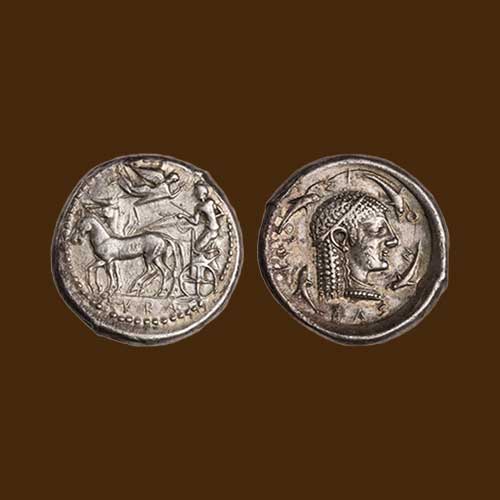
Artistically, Nike is typically portrayed as a winged figure, often depicted in a flowing robe and appearing to move with great swiftness. Her image has appeared on coins since 500 BCE, representing her enduring legacy. The coin featured in this post is a Silver Tetradrachm from Syracuse, a Greek colony on the east coast of Sicily in Italy. With a dia of 27mm and a weight of 17.16 gm, it features a Quadriga (a two-wheeled chariot drawn by four horses harnessed abreast) driven by a charioteer and flying Nike crowning him from above on the obverse. It also bears a Greek inscription ‘SVRA’, an abbreviation for Syracuse.
The reverse features a bust of the nymph Arethusa, who, according to a legend, fled from the river-god Alpheios. Upon reaching Ortygia (Syracuse), she prayed to Artemis, the protector of young women, for assistance and was transformed into a spring. Arethusa is depicted with dolphins, which were prevalent in the waters surrounding Ortygia in ancient times. It also has a Greek inscription SVRAQOSION.
Latest News
-
Greek And Roman Deities On Coins-8
2026-01-17 SatIn ancient Greek tradition, Artemis is revered as the goddess of nature, childbirth, wildlife, Heali...
-
One-Eighth Tanka of Malwa Sultan Mahmud Shah II
2026-01-17 SatMahmud Shah II was the last ruler of the Khalji dynasty, governing the Malwa Sultanate from 1510 to ...
-
Greek And Roman Deities On Coins-7
2026-01-16 FriIn ancient Greek tradition, Zeus holds the esteemed position of a chief deity. Revered as the god of...
-
Greek And Roman Deities On Coins-6
2026-01-15 ThuIn ancient Greek religion and tradition, the twelve Olympians represent the principal deities of the...
-
Malwa Sultan Mahmud Shah II's Silver Half Tanka
2026-01-14 WedMahmud Shah II, the last ruler of the Malwa Sultanate, ruled from AH 916 to 937 (1510–1531 CE). Hi...