
Greek And Roman Deities On Coins-7
2026-01-16 Fri
In ancient Greek tradition, Zeus holds the esteemed position of a chief deity. Revered as the god of the sky and thunder, he is recognized as the King of the twelve Olympian gods. Zeus is believed to uphold Justice and ensure order among both DIVINE and mortal beings from his #Throne on Mount Olympus.He is the youngest son of Cronus, leader of the Titans, and Rhea, Mother of the Gods. He was born in a secluded #cave on Mount Ida in Crete, where his mother sought refuge to protect him from Cronus. Fearing a prophecy that foretold his downfall at the hands of one of his children, Cronus swallowed each offspring immediately upon their birth. After Zeus’s birth, Rhea deceives Cronus by presenting him with a stone wrapped in swaddling clothes, which he consumes without realizing it was not his son. Ultimately, as an adult, Zeus emerges victorious after battling the Titans.
In artistic representations from ancient #Greece, Zeus is typically depicted as a bearded figure, often holding a thunderbolt or a scepter, symbolizing his authority and power. Interestingly, the imagery of Zeus appeared on coins later than that of his offspring, such as Athena, Heracles, Perseus, Apollo, and Dionysus. His portrait has been featured on coins since 520 BCE.
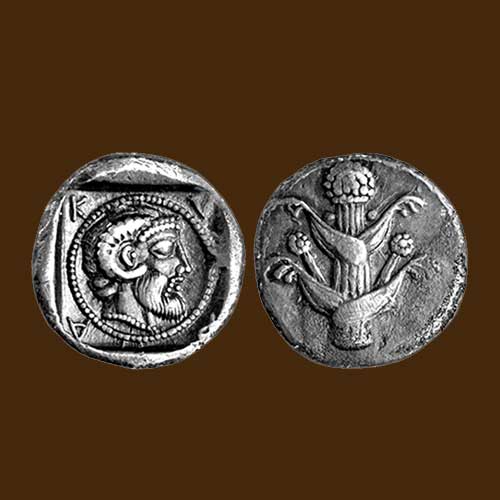
The coin featured on this post is a Silver Drachma from Cyrene, an ancient Greek city located in northeastern Libya, dating from 480 BCE - 435 BCE. The obverse showcases an image of a bearded face of Zeus adorned with ram’s horns, representing the hybrid deity known as 'Zeus Ammon.' Ammon was a deity worshipped by the people of Libya and Egypt. This coin illustrates the synthesis of #Egyptian and Greek pantheons, exemplifying the cultural intermingling and reverence for the hybrid figure of Zeus-Ammon. It also features the Greek inscription ‘KVPA,’ an abbreviation for Cyrene. Ancient Greek coins often used an initial letter or a few letters of the issuing city-state to declare their identity and guarantee their value.
On the reverse is an extinct plant known as Silphium, which was highly valued for its medicinal properties and the perfumes derived from its Flowers. It played a significant role in the economy of Cyrene.
Latest News
-
Greek And Roman Deities On Coins-6
2026-01-15 ThuIn ancient Greek religion and tradition, the twelve Olympians represent the principal deities of the...
-
Malwa Sultan Mahmud Shah II's Silver Half Tanka
2026-01-14 WedMahmud Shah II, the last ruler of the Malwa Sultanate, ruled from AH 916 to 937 (1510–1531 CE). Hi...
-
Greek And Roman Deities On Coins-5
2026-01-14 Wed#Greek traditions and folktales are rich with stories and #Legends, which are also reflected in vari...
-
Greek And Roman Deities On Coins-4
2026-01-13 TueAquatic creatures have consistently been a significant subject of human artistic expression, as seen...
-
Greek And Roman Deities On Coins-3
2026-01-13 TueHerakles, also known as Hercules in Roman mythology, is one of the most celebrated heroes in Greek M...