
Science and Technology on Indian Postage Stamps-23
2025-12-31 Wed
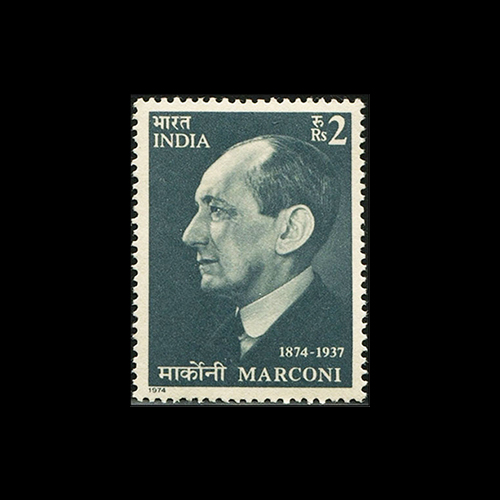
Guglielmo Marconi was an esteemed Italian engineer, inventor, and POLITICIAN recognized for his groundbreaking achievements in long-distance radio transmission. He developed the first successful long-distance wireless telegraph in 1894 and achieved the transmission of the first transatlantic radio signal in 1901. Marconi's remarkable contributions to radio communications earned him the Nobel Prize in physics in 1909, an accolade he shared with the German physicist Karl F. Braun. His innovations significantly enhanced maritime security and communications, playing a crucial role in saving lives during maritime disasters such as the sinking of the RMS Titanic in 1912 and the RMS Lusitania in 1915.Born on 25 April 1874, in Bologna, Italy, Marconi belonged to a noble family. He was the second son of Giuseppe Marconi, an Italian country aristocrat, and Annie Jameson, who was of Irish descent. Throughout his early years, Marconi did not receive formal education, instead learning from a series of private tutors selected by his family.
By the age of twenty-one, Marconi embarked on his journey in wireless communication, achieving initial successes in 1895. His endeavors were built upon the discoveries of radio waves made by Heinrich Hertz just a few years prior. Seeking to protect his intellectual property and secure venture capital, Marconi relocated to London in 1896, where he established the Wireless Telegraph & Signal Company (later renamed as Marconi's Wireless Co.) in July 1897.
Marconi's pioneering work led to significant milestones, including the successful crossing of the English Channel in 1899 and the groundbreaking transatlantic radio link in 1901. On 12 December of that year, he received the first transatlantic wireless signal transmitted from Poldhu in Cornwall to St. John's, Newfoundland.
Following World War I, the Marconi Company played an instrumental role in establishing long-distance wireless communication, facilitating the emergence of broadcasting. On 15 June 1920, the company conducted what is considered the first pre-announced broadcast of public entertainment, featuring a performance by the renowned Australian opera soprano Dame Nellie Melba, who sang via radio from the Marconi facility in Chelmsford.
The company continued its experimental broadcasts throughout 1921, and on 11 May 1922, the London radio station 2LO commenced its transmissions from the roof of Marconi House. This studio later became the first station of the British Broadcasting Company, officially incorporated on 18 October 1922.
It is noteworthy that Jagadish Chandra Bose, an Indian scientist, made significant contributions to radio #Technology, including the demonstration of millimeter waves and the invention of the coherer in 1895. However, he did not pursue patents for his work, allowing Marconi to build upon and commercialize these advancements, resulting in Marconi receiving widespread recognition for the invention of radio, despite Bose's foundational contributions.
To know more about him, refer to Science and Technology on Indian Postage Stamps-5
Marconi's later work included advancements in microwave technology. He later suffered multiple heart attacks in the years leading up to his death, which occurred on 20 July 1937, in Rome at the age of 63.
In recognition of his significant contributions to long-distance wireless telegraphy and the advancement of radio technology, India post honored Guglielmo Marconi with a commemorative stamp on 12 December 1974, marking the birth centenary. His legacy continues to have a profound impact on global communication and safety.
Latest News
-
Science and Technology on Indian Postage Stamps-22
2025-12-31 WedNicolaus Copernicus is regarded as a significant figure in the History of science, recognized for hi...
-
Science and Technology on Indian Postage Stamps-21
2025-12-30 TueLeprosy, also known as Hansen’s disease, is a chronic infectious disease caused by the bacterium M...
-
Science and Technology on Indian Postage Stamps-20
2025-12-29 MonVikram Sarabhai, ‘Father of the Indian Space Program,’ played a pivotal role in the advancement ...
-
Science and Technology on Indian Postage Stamps-19
2025-12-26 FriSir Chandrasekhara Venkata Raman, widely recognized as C.V. Raman, was a distinguished Indian physic...
-
Science and Technology on Indian Postage Stamps-18
2025-12-23 TueIn the 1950s, the United States and the Soviet Union were engaged in a significant Competition known...