
Science and Technology on Indian Postage Stamps-13
2025-12-08 Mon
Wheat is recognized as the second most crucial staple Food crop in India, following rice, and plays a vital role in the country's food security, Nutrition, and agricultural Economy. This crop has maintained its prominence globally since prehistoric times and later emerged as a key component of the GREEN Revolution that began in Mexico during the 1940s. In response to significant food shortages, scientists, led by agronomist Norman Borlaug at the International Maize and Wheat Improvement Center, developed a new wheat variety with enhanced disease resistance and superior yield capacity. This led to countries adopting this variety, resulting in self-sufficiency and the capability to Export surplus produce. In the late 1960s, this high-yielding variety was introduced to India, marking the start of the Revolution. This revolution was the initial and most successful phase of India’s broader Green Revolution.Wheat had been grown in India for centuries, yet yields stayed stubbornly low, creating a growing shortfall that forced the country to rely heavily on imports. In the 1960s, India faced a critical challenge, importing 10 million tons of wheat from the United States to meet domestic demands. To tackle this issue, the Indian Agricultural Research Institute (IARI) in New Delhi introduced New Mexican wheat varieties in 1963. Collaborating with agricultural universities and state agricultural departments, high-yielding varieties such as Lerma Rojo and Sonora 64 were identified, capable of producing up to 6 tonnes per hectare. This initiative led to the rapid adoption of these new varieties across millions of hectares, significantly boosting wheat production. Dr. M.S. Swaminathan, regarded as the 'Father of the Indian Green Revolution', was instrumental in driving this agricultural transformation in India.
The Wheat Revolution represented a pivotal change in India's agricultural landscape, particularly in the domain of wheat cultivation. It integrated modern science and Technology into #farming practices, promoting advancements in seed #Engineering, sophisticated irrigation systems, machinery for ploughing and harvesting, as well as chemical fertilizers and pesticides. This revolution not only transformed agricultural practices but also shifted the mindset of rural communities. Notably, production surged in Punjab, Haryana, and western Uttar Pradesh, with Punjab alone generating 70% of India's food grain by 1970, earning the title “Food Bowl of India.” Moreover, new wheat varieties such as Kalyansona, Sharbati Sonora, Sonalika, Safed Lerma, and Chhoti Lerma played significant roles in the success of this movement.
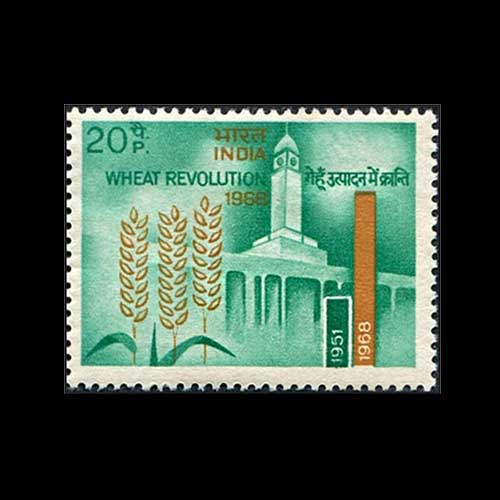
On 17 July 1968, India Post commemorated the Wheat Revolution by issuing a stamp that celebrated the remarkable achievements of the Green Revolution. This stamp, unveiled by former Prime Minister Indira Gandhi, features imagery of wheat stalks with the IARI in the background, alongside bar graphs illustrating production growth from 1951 to 1968.
For further insights into the archaeological aspects of wheat, please refer to the following link: Fascinating Archaeological Facts on Postage Stamps - 76
Latest News
-
Science and Technology on Indian Postage Stamps-12
2025-12-08 MonThe survey of India (SOI) serves as the principal mapping and surveying agency across the country. E...
-
Science and Technology on Indian Postage Stamps-11
2025-12-05 FriDr. Homi Jehangir Bhabha was one of India's most esteemed scientists and is widely recognized as the...
-
Science and Technology on Indian Postage Stamps-10
2025-12-05 FriIn the mid-19th Century, the geological community in Europe and North America recognized the need fo...
-
Science and Technology on Indian Postage Stamps-9
2025-12-04 ThuWaldemar Mordechai Wolff Haffkine was a distinguished Russian-French bacteriologist renowned for his...
-
Gold Tanka of Malwa Sultan Nasir Shah
2025-12-04 ThuNasir Shah, the son of Ghiyath Shah, ascended to the throne of the Malwa Sultanate in the Hijri year...