
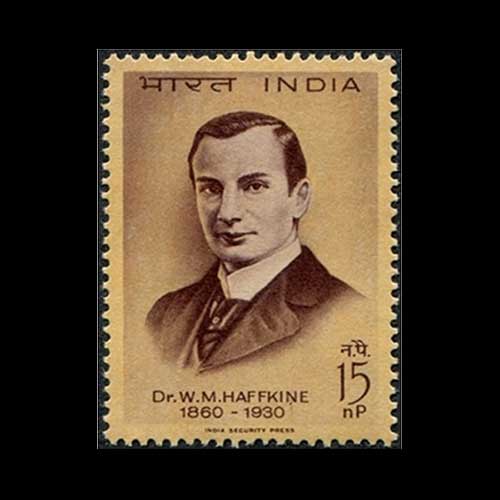
Science and Technology on Indian Postage Stamps-9
2025-12-04 Thu
Waldemar Mordechai Wolff Haffkine was a distinguished Russian-French bacteriologist renowned for his pioneering contributions to the field of vaccines. Born on 15 March 1860 in Odessa, within the Russian Empire, he is acknowledged as the first microbiologist to successfully develop and implement vaccines against cholera and bubonic plague.Haffkine graduated with a doctor of Science (http://D.Sc) degree and served as the Curator at the Zoological Museum until 1888. According to H. I. Jhala in ‘W. M. W. Haffkine, Bacteriologist - A Great Saviour of Mankind,’ Odessa emerged as a significant center for microbiological studies during this time, a field dedicated to understanding microscopic forms of life. The city also produced esteemed scientists like Elie Metchnikoff, who introduced the influential theory of cellular defense by white blood cells against bacteria.
In 1888, Haffkine relocated to Switzerland, where he joined the University of geneva as a physiology instructor. In 1890, he followed Metchnikoff to the Pasteur Institute in Paris, which had been established through the efforts of the eminent microbiologist Louis Pasteur. Although Haffkine initially held the position of Assistant LIBRARIAN, he was actively involved in Research within Metchnikoff’s laboratory.
During this period, one of the five significant cholera pandemics of the 19th century was affecting both Asia and Europe. Following Pasteur's advocacy for preventive measures over curative strategies, Haffkine concentrated his research on the development of a cholera vaccine. Remarkably, he succeeded in stabilizing the cholera VIRUS and conducted the first human trial on himself to test its efficacy.
Lord Frederick Dufferin, British Ambassador to Paris and a former Viceroy of India (1884–88), recommended testing the new vaccine in Bengal, and British officials facilitated Haffkine's journey to India. Upon his arrival in Calcutta in March 1893, he joined Presidency Hospital as a bacteriologist, where he established a long-standing connection with India and its people.
In 1896, a significant outbreak of bubonic plague arose in Asia; with a fatality rate nearly double that of cholera. Haffkine traveled to Bombay, where he established a laboratory at Grant Medical College, dedicating himself to the development of the world’s first plague vaccine from scratch. Following extensive research, he achieved successful results in Animal testing and, on 10 January 1897, self-administered the vaccine. He subsequently conducted trials at the Byculla House of Correction, inoculating 143 prisoners.
Aga Khan, the spiritual leader of the Khoja sect, also stepped forward to receive the inoculation, which encouraged widespread participation among his followers. Within a year, over half a million individuals had received the vaccine. In recognition of his efforts, Haffkine was knighted by Queen Victoria and appointed as the director of the Plague Research Laboratory in Bombay. This facility not only focused on plague and cholera but also addressed other diseases, including typhoid, Malta fever, diphtheria, leprosy, and smallpox. It played a vital role in bacteriological training and the implementation of anti-plague measures.
However, in 1902, in Punjab's Mulkowal village, 19 people died from tetanus after receiving Haffkine’s vaccine. An inquiry conducted by the Indian government revealed that Haffkine had altered the sterilization process of his vaccines. By 1903, the commission concluded that the contamination of bottle 53N in Haffkine’s laboratory was the source of the infection. Evidence later showed that the rubber bung of the bottle had dropped to the ground from the hands of an English doctor, Elliot, while inoculating the victims in Mulkowal. The bung was then refixed on the bottle, which led to contamination with dust that contained tetanus germs.
Following a vigorous protest by fellow scientists and Medical professionals, including Ronald Ross, William R. Smith, and Simon Flexner, the British Government exonerated Haffkine in 1907 and appointed him as the director of the Calcutta Biological Laboratory.
Upon retiring in 1914, Haffkine returned to France and later moved to Lausanne, Switzerland, where he spent his remaining years. In recognition of his significant contributions to Public Health, India Post issued a special commemorative stamp honoring Waldemar Mordechai Wolff Haffkine on 16 March 1964.
Latest News
-
Gold Tanka of Malwa Sultan Nasir Shah
2025-12-04 ThuNasir Shah, the son of Ghiyath Shah, ascended to the throne of the Malwa Sultanate in the Hijri year...
-
Science and Technology on Indian Postage Stamps-8
2025-12-04 ThuAcharya Prafulla Chandra Ray is regarded as one of the most distinguished scientists and industriali...
-
Science and Technology on Indian Postage Stamps-7
2025-11-29 SatAkashvani, also known as All India Radio (AIR), was established in 1936 and functions under the Mini...
-
Science and Technology on Indian Postage Stamps-6
2025-11-12 WedSir Mokshagundam Visvesvaraya is regarded as one of India's most distinguished engineers. His innova...
-
Science and Technology on Indian Postage Stamps-5
2025-11-11 TueSir Jagadish Chandra Bose recognized as India's first biophysicist was born on 30 November 1858, in ...