
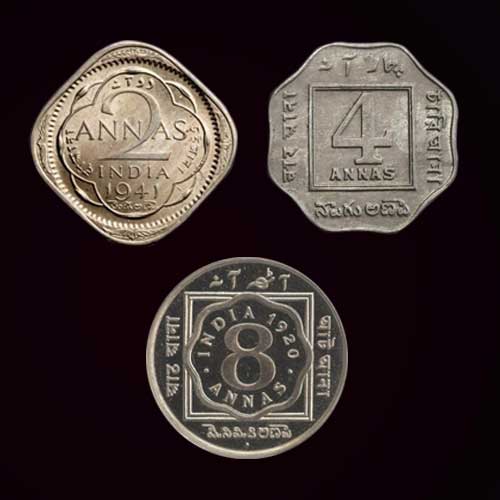
British Base Metal 2 Anna, 4 Anna and 8 Anna Introduced
2023-02-02 Thu
During the World War (1914 -1919) the prices of precious metal like silver shoot up. Precious metal reserves were the lowest as it was used for war time efforts. Nearly by the end of 1918, the British India government under King George V decided to discontinue minting the fractional coins in silver. In place of silver fraction copper-nickel fraction of 2 Anna, 4 Anna and 8 Anna were introduced and this practice remained till the independence. To distinguish them from silver fractions the looks of 2 Anna and 4 Anna changed altogether, while 8 Anna though round carried new design and style with multi-lingual denomination.Denomination: 2 Anna, 4 Anna and 8 Anna
Shape: Square, scalloped, square surrounded.
Metal: copper nickel
Image courtesy: mintage world
Latest News
-
Elephant on a Punch-Marked Coin of the Vidarbha Janapada
2026-09-23 WedThe history of Indian coinage begins with the remarkable tradition of punch-marked coins, among t...
-
Gandabherunda and Four Elephants on a Gold Half Varaha of Achyutadevaraya
2026-09-23 WedThe Gandabherunda, the mythical two-headed bird of Indian tradition, is one of the most striking ...
-
The Elephant on an Indo-Greek Silver Drachm of Apollodotus I
2026-09-22 TueElephants were not just an important part of Indian heritage and religious traditions; they also ...
-
Gajalakshmi Flanked by Elephants on a Post-Mauryan Ujjaini Copper Coin
2026-09-22 TueThe association between Gajalakshmi and elephants is one of the most enduring motifs in Indian re...
-
Elephant Head on a Bronze Coin of Indo-Scythian King Maues
2026-09-21 MonAs the eighth day of Ganesh Utsav is celebrated, the elephant once again provides a fascinating l...