
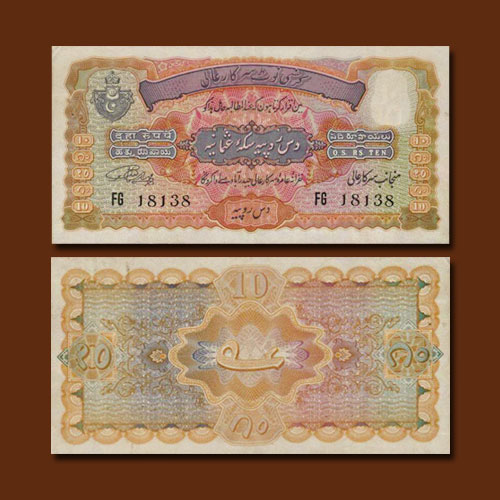
Hyderabad Banknotes
2020-02-28 Fri
Mir Qamar-ud-Din, the Mughal Viceroy of the Deccan claimed an independent title Asaf Jah and founded the Princely State of Hyderabad.The coins of the Nizams were issued in the name of the Mughal Emperor till 1858 after which new coins were struck independently called ‘Hali Sicca’, i.e., the current coins. The Government of Hyderabad tried to organize private bankers and local ‘saucers’ to set up a banking company that could issue Hyderabad paper money as well. The British did not allow this to happen. In 1918 though, due to the shortage of silver and due to Hyderabad’s and India’s contributions in the First World War, special Princely State paper currency in denominations of Rupees 100 and Rs 10 was issued under the Hyderabad Currency Act. These notes dated back to the ‘Fasil’ era. Unlike the ‘Hijri’ Calendar, it was Solar and the names of the months were Persian in origin.
Hyderabad currency was designated the Osmania Sicca and the notes were printed by Messrs Waterlow and Sons. In 1919, Rupee One and Rupees Five notes were issued. Rupees One Thousand notes were issued in 1926.
Latest News
-
Twin Fishes and Bull on a Pandya Copper Coin
2026-09-28 MonThe Pandyas were one of the three great Tamil dynasties of the Sangam age, alongside the Cheras a...
-
Sangam-Age Chola Copper Coin with Lion/Tiger, Elephant and Auspicious Symbols
2026-09-28 MonThe Cholas were one of the three major Tamil dynasties of the Sangam age, alongside the Cheras an...
-
Elephant and Lion on a Copper Coin of the Sangam Cholas
2026-09-24 ThuThe elephant and lion were powerful animal symbols in the artistic and political traditions of an...
-
Ganesha and Shiva Together on a Coin of the Shiv Ganga Rajas
2026-09-25 FriOn Anant Chaturdashi, devotees bid farewell to Lord Ganesha with prayers and devotion, celebratin...
-
Elephant on a Punch-Marked Coin of the Vidarbha Janapada
2026-09-23 WedThe history of Indian coinage begins with the remarkable tradition of punch-marked coins, among t...