
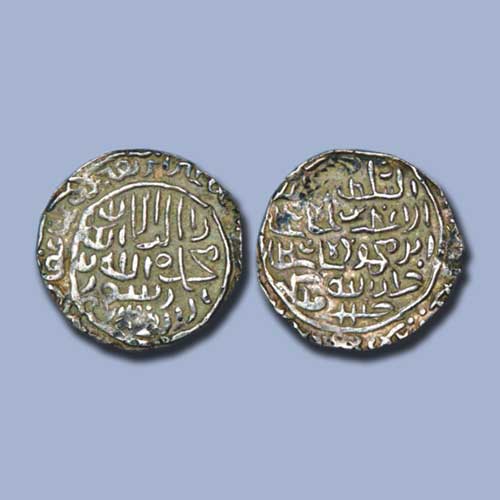
Rukn-al-din Barbak Silver Tanka
2019-04-16 Tue
Rukn-al-din Barbak Shah was the ruler of Bengal Sultanate, he was the son of Sultan Nasiruddin Mahmud Shah, during the reign of his father he was appointed as governor of Satgaon. He sat on the throne of Bengal Sultanate after the death of his father in the year 1459. He ruled Bengal Sultanate from 1459 CE till 1474 CE.Rukn-al-din Barbak Shah was a patron of scholars and poet, both Muslim and Hindu scholars. He is well known in recruiting eight thousand Abyssinian slaves and also employed in the army if Bengal Sultanate in various posts. He is also remembered as a good administrator and lover of justice and kind-hearted. During his reign, many Hindu played a prominent in both his civil and military administration.
This silver tanka issued by him weighs around 10.58g. The obverse of this coin is inscribed with ‘Shahada within the central circle’ and the name of Rashidoons and their title written in the margin. The reverse of this coin is inscribed as ‘Al-Sultan Al-Adil Al-Azam Barbak Shah Sultan Khallada Allah Mulkahu Wa Sultanahu’ within the circle.
Image Courtesy: Classical Numismatic Gallery
Latest News
-
Goddess Lakshmi in Padmasana Posture on a Rare Kakatiya Gold Gadyana Coin
2026-11-19 ThuThe Kakatiya dynasty was an important ruling power in the Deccan, with its influence centred arou...
-
Chalukyan-style Temple on Gold Gadyana
2026-11-19 ThuThe Chalukyas of Kalyani, also known as the Western Chalukyas, were an influential ruling dynasty...
-
An Interesting Five-Symbols on Punch-Marked Copper Square Karshapana of Eran
2026-11-18 WedThe ancient region of Eran, situated in present-day Madhya Pradesh, was an important centre of ea...
-
Sacred Symbols and Natural Motifs on Post-Mauryan Coinage of the Eran-Vidisha Region
2026-11-18 WedThe decline of the Mauryan Empire in the second century BCE marked the emergence of several regio...
-
Mithuna (Couple) Type Coin from the Post-Mauryan Ujjaini Region
2026-11-17 TueContinuing our exploration of the distinctive coinage of the Post-Mauryan Ujjaini region, let us ...