
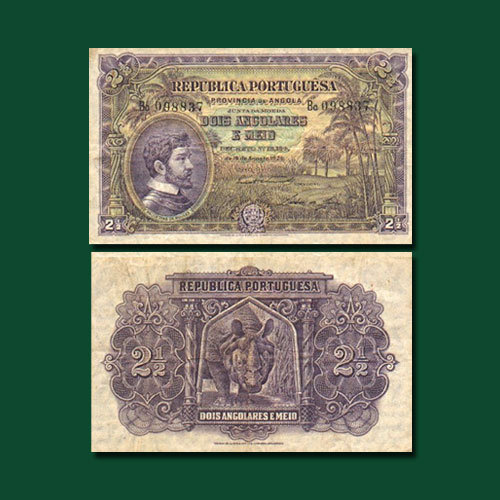
Angola 2 1/2 Angolares banknote of 1926 Republica Portuguesa
2019-03-14 Thu
Angola is a Southern African nation whose varied terrain encompasses tropical Atlantic beaches, a labyrinthine system of rivers and Sub-Saharan desert that extends across the border into Namibia. The country's colonial history is reflected in its Portuguese-influenced cuisine and its landmarks including Fortaleza de Sao Miguel, a fortress built by the Portuguese in 1576 to defend the capital, Luanda.The Angolar was the currency of Portuguese Angola between 1928 and 1958. It was subdivided into 100 centavos or 20 macutas. Angolar is Portuguese for "of Angola". The angolar was introduced in 1928 to replace the escudo. In 1928, the Junta de Moeda introduced notes (dated 1926) in denominations of 1, 2½, 5 and 10 angolares, whilst the Bank of Angola introduced 20, 50, 100 and 500 angolar notes dated 1927.
The banknote depicted alongside is a 2 and ½ angolares banknote issued in 1926. The obverse has the portrait of Paulo Dias de Novais at lower left, a Savanna landscape at right, and the Portuguese Coat of Arms at lower center. The Reverse has a Rhinoceros at center and the denominational value in ornate guilloches at left and right.
Image Courtesy: Banknote world
Latest News
-
Science and Technology on Indian Postage Stamps-14
2025-12-09 TueMarie Curie, a distinguished POLISH-born physicist and chemist, is widely recognized as one of the m...
-
Science and Technology on Indian Postage Stamps-13
2025-12-08 MonWheat is recognized as the second most crucial staple Food crop in India, following rice, and plays ...
-
Science and Technology on Indian Postage Stamps-12
2025-12-08 MonThe survey of India (SOI) serves as the principal mapping and surveying agency across the country. E...
-
Science and Technology on Indian Postage Stamps-11
2025-12-05 FriDr. Homi Jehangir Bhabha was one of India's most esteemed scientists and is widely recognized as the...
-
Science and Technology on Indian Postage Stamps-10
2025-12-05 FriIn the mid-19th Century, the geological community in Europe and North America recognized the need fo...