
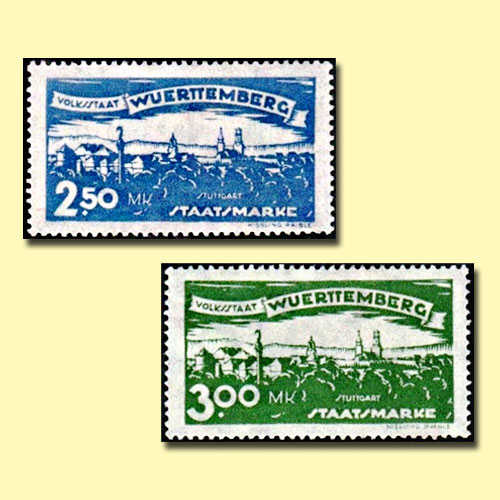
Views of Stuttgart on Wurttemberg Stamps
2019-01-08 Tue
Wurttemberg Stamps featuring the city view of Stuttgart were the stamps used by the Republic of Wurttemberg, after the end of World War I. These state or ministerial official stamps were issued for use on official correspondence between state government offices.Stamps shown above are among the set of ten pictorial state official stamps. Issued on March 25th, 1920, the designs feature views of Stuttgart - the capitol, Ulm, Tubingen, and Ellwangen. They are inscribed with "Volkstaat / Wurttemberg" or "People's State of Wurttemberg" at the top.
The denomination value is in the bottom right corner of the stamps except for two stamps with the denominations of 30 German reichspfennig and 1.25 German reichsmark which depict the denomination in the bottom left corner.
State official stamps of the People's Republic of Wurttemberg were discontinued after 1920 when it became a member state within the German Weimar Republic. Today, Wurttemberg is part of the state of Baden-Wurttemberg, within the Republic of Germany.
Image Courtesy: https://colnect.com
Visit philamart to view and purchase variety of stamps from all over the world
Latest News
-
Goddess Lakshmi in Padmasana Posture on a Rare Kakatiya Gold Gadyana Coin
2026-11-19 ThuThe Kakatiya dynasty was an important ruling power in the Deccan, with its influence centred arou...
-
Chalukyan-style Temple on Gold Gadyana
2026-11-19 ThuThe Chalukyas of Kalyani, also known as the Western Chalukyas, were an influential ruling dynasty...
-
An Interesting Five-Symbols on Punch-Marked Copper Square Karshapana of Eran
2026-11-18 WedThe ancient region of Eran, situated in present-day Madhya Pradesh, was an important centre of ea...
-
Sacred Symbols and Natural Motifs on Post-Mauryan Coinage of the Eran-Vidisha Region
2026-11-18 WedThe decline of the Mauryan Empire in the second century BCE marked the emergence of several regio...
-
Mithuna (Couple) Type Coin from the Post-Mauryan Ujjaini Region
2026-11-17 TueContinuing our exploration of the distinctive coinage of the Post-Mauryan Ujjaini region, let us ...