
Punishments in Ancient Greek
2017-12-13 Wed
In history, there was always the concept of punishment against the violations of the society’s law. The ancient civilization had their own punishment system, thus there are many references to these practices of the bygone world can be seen in scriptures and paintings. Greece being one of the ancient and mature societies of its time, developed its own commandments and charters to operate smoothly.The concept of law and guidelines to safeguard their citizens is ancient Greek was very rustic. The punishment system was divided into two types. The one cursed upon you by the gods and the one given by mortals (Humans). The punishment is Odyssey was given due to the lack of respect to the concept of law and regulation by the characters in it.
The practices of law were not clear till 900 BCE in ancient Greece. Slow advancement in the society developed the importance of rules and regulations. Till 620 BCE Greeks had their first known written laws by Draco. The laws created by Draco were quite harsh, due to this Solon changed all the laws of Draco except for ‘the law that establishes exile as the penalty for homicide’.
The concept of the trail was not foreign in Greece. The trail for severing crimes was held by the juries of at least 200 male citizens of Greece. Due to this system anybody could bring charges against anybody and start a trial.
The few examples of punishment in Greek are: Exile was common punishment for homicide and ostracism for the political crime. 100 drachms was a fine for committing rape. The punishment for murder was executed by throwing the culprit in Baratheon Rhaphanidosis. It was one of the cruellest punishments known in ancient Greece.
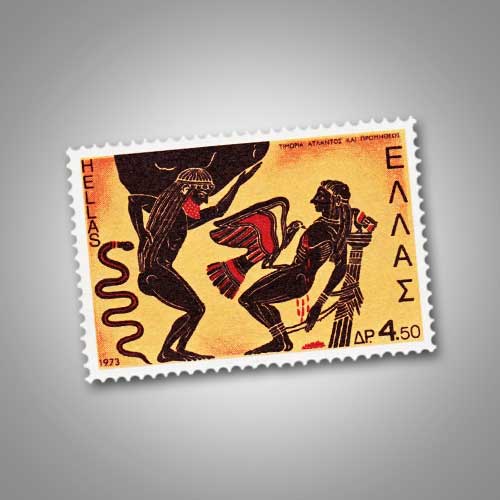
The punishments given to the mythical gods resulted in lifelong sufferings. In the story of Atlas and Prometheus, Atlas was punished to bear the weight of the sky on his shoulder. This punishment was given by Olympians after they defeated the Titans in Titanomachy. Prometheus stole fire from heaven and gave it to mortals. This was a crime in eyes of the gods, so he was chained to a remote mountain and Zeus’ eagle ate his liver.
The above lore is depicted on a stamp issued by the Greek Post in 1973. The picture depicted in this stamp is originally painted on the bottom of a shallow mixing bowl (Kalyx Crater).
The making of law and punishment are given for the violation of these laws was the concept followed by the ancient people. India also had four different law books for the four ‘yugas’. The law was updated as the time progressed and the perception of the society changes.
Today basic law of all the society throughout the globe is same, do and don’t follow by the citizen of various countries today is based on humanism.
To know more about Greek Click here.
Latest News
-
Bow and Arrow on an Ancient Chera Copper Coin of the Sangam Age
2026-10-09 FriIn our ongoing series exploring the coinage of the Sangam Age, this uninscribed copper coin attri...
-
Symbolic Motifs on an Ancient Chola Copper Coin of the Sangam Age
2026-10-09 FriThe Chola dynasty was one of the three great ruling houses of ancient Tamilakam, alongside the Ch...
-
Iconography of Chera Dynasty on a Square Copper Coin
2026-10-08 ThuThe Cheras were one of the three great crowned dynasties of ancient Tamilakam, alongside the Chol...
-
Decoding the Symbols of a Sangam Age Pandyan Copper Coin
2026-10-08 ThuThe Sangam age is generally placed broadly between c. 300 BCE and 300 CE, although the chronology...
-
Royal Emblems on a Gold Kahavanu of Rajendra Chola
2026-10-07 WedRajendra Chola I (1012–1044 AD) was one of the most powerful rulers of the Chola dynasty and th...