
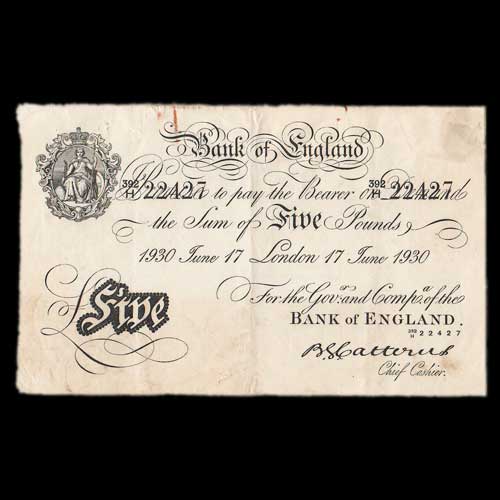
English Paper Money
2017-11-07 Tue
The banknotes of England had a scattered start in the beginning of 17th century and witnessed its expansion throughout the Industrial Revolution. The regulation and amalgamation of these banknotes in the later 19th and early 20th centuries reflects the wider spread of Britain’s economic development.In the reign of Queen Elizabeth I, the word ‘Banker’ was used to refer to an exchange broker. The first Bank of England was established to raise money for King William III’s war against France. The Bank started to issue a note in return of deposits. These bankers were the goldsmith-banker, who began to accept deposits. The transfer of loan and funds and gave receipts for cash.
These early receipts were known as ‘Running cash notes’. These were made out in the name of the depositors and promised to pay him on demand. Many of these also carried the world ‘or bearer’ after the name of depositor which allowed the money to regulate in a restricted manner. The phrase ‘I promise to pay the bearer on demand the sum of ...’ still depicted on English Banknotes till date.
In 1694 the bank of England started issuing a note in return of deposit. These notes were initially hand written in the start and were signed by the cashiers. Today all the British banknotes illustrate Chief Cashier’s signature. The smallest denomination was £ 50. Many people at that time have not seen these notes; the average annual income was less than £ 20.
To know more about England’s paper money click here.
Latest News
-
Science and Technology on Indian Postage Stamps-27
2026-01-03 SatAlexander Graham Bell, a Scottish-born scientist and Engineer, is widely recognized for patenting th...
-
Science and Technology on Indian Postage Stamps-26
2026-01-02 FriThe India Meteorological Department (IMD) functions as a key agency under the Ministry of Earth Scie...
-
Science and Technology on Indian Postage Stamps-25
2026-01-01 ThuThe Satellite Instructional Television Experiment (SITE) was a pioneering satellite communications p...
-
Science and Technology on Indian Postage Stamps-24
2026-01-01 ThuAryabhata, named after an ancient Indian mathematician and astronomer from the 5th century CE, was I...
-
Malwa Sultan Nasir Shah Copper Falus
2026-01-01 ThuThe Malwa Sultan Nasir Shah initially continued the 100 rati standard introduced by his father, Ghiy...