
Science and Technology on Indian Postage Stamps-29
2026-01-05 Mon
Homeopathy is a widely recognized system of Medicine that continues to attract patients seeking relief from various ailments. This system of alternative medicine was established by German physician Samuel Hahnemann in 1796, stemming from his dissatisfaction with contemporary medical practices. Hahnemann’s approach involved extensive experimentation in chemistry and the translation of scientific Literature. The foundation of homeopathy is based on the principle of ‘Similia Similibus Curentur,’ which translates to ‘like cures like.’ This principle implies that a substance that induces symptoms in healthy individuals may also alleviate similar symptoms in those who are ill.Hahnemann introduced the terminology of "Homeopathy," derived from the Greek words "homoios" meaning "similar," and "pathos" meaning "suffering." He also coined the term "Allopathy," combining the Greek words "allos," meaning "different," and "pathos." His method of drug application involved administering highly diluted medications while emphasizing gentler approaches to restoring #Health in patients.
Throughout the early 19th Century, homeopathy experienced significant growth in European countries, including Austria, Hungary, Italy, Denmark, France, England, Spain, and Belgium. It made its entry into #India in 1810, facilitated by German missionaries who distributed homeopathic medicines. The practice gained further traction during cholera outbreaks and other epidemics. Over time, homeopathic dispensaries, hospitals, educational institutions, and pharmacies were established across India, making it a widely embraced system of #healthcare. Notably, in 1839, Dr. John Hoenigberger treated Maharaja Ranjit Singh for paralysis of the vocal cords, thereby promoting the Practice. Official recognition of homeopathy began with a government resolution in 1937, followed by another resolution in 1948. In 1973, a Central Act was passed, recognizing this system of medicine.
Today, homeopathy constitutes a significant component of India’s pluralistic healthcare framework. Homeopathy, alongside other traditional Medical systems such as Ayurveda, yoga, Naturopathy, Unani, Siddha, and Sowa Rigpa, falls under the jurisdiction of the Department of AYUSH within the Ministry of Health and Family Welfare, Government of India. These systems are officially recognized and are practiced widely across India in both public and private sectors. Furthermore, India boasts the largest community of homeopathic practitioners globally, with approximately 2, 40,000 licensed homeopaths.
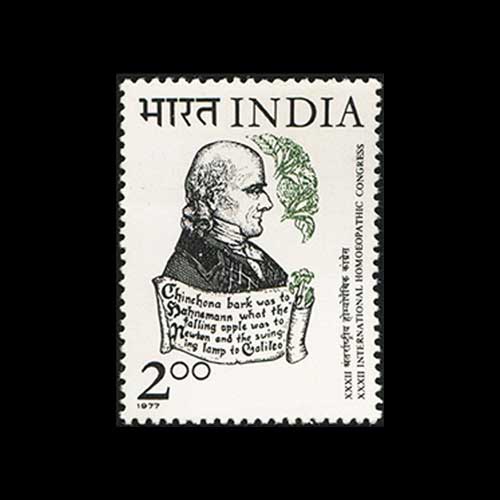
On 06 October 1977, India Post issued a commemorative stamp celebrating the XXXII International Homeopathic Congress held in NEW Delhi from 06-11 October 1977. The design of the stamp features a portrait of Dr. Samuel Hahnemann, the founder of homeopathy, alongside twigs from the Cinchona plant. This botanical connection is significant, as Hahnemann’s studies of Cinchona BARK were pivotal in formulating homeopathy’s core principle, Similia Similibus Curentur.
Latest News
-
Science and Technology on Indian Postage Stamps-28
2026-01-05 MonBerliner Gramophone was an American record label, recognized as the first and, for nearly a decade, ...
-
Science and Technology on Indian Postage Stamps-27
2026-01-03 SatAlexander Graham Bell, a Scottish-born scientist and Engineer, is widely recognized for patenting th...
-
Science and Technology on Indian Postage Stamps-26
2026-01-02 FriThe India Meteorological Department (IMD) functions as a key agency under the Ministry of Earth Scie...
-
Science and Technology on Indian Postage Stamps-25
2026-01-01 ThuThe Satellite Instructional Television Experiment (SITE) was a pioneering satellite communications p...
-
Science and Technology on Indian Postage Stamps-24
2026-01-01 ThuAryabhata, named after an ancient Indian mathematician and astronomer from the 5th century CE, was I...