
Science and Technology on Indian Postage Stamps-24
2026-01-01 Thu
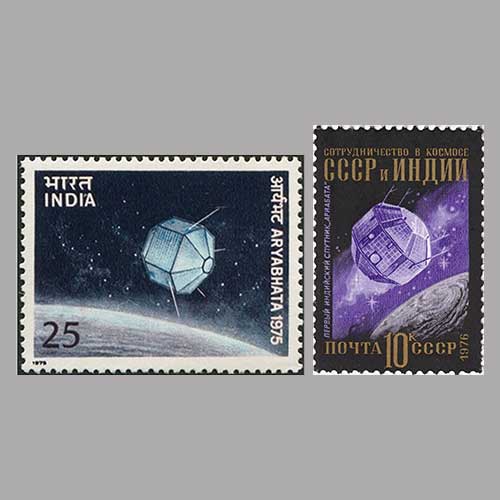
Aryabhata, named after an ancient Indian mathematician and astronomer from the 5th century CE, was India’s inaugural satellite, marking a significant milestone in the country’s Space exploration journey. Constructed over a span of just 30 months by a dedicated team of young Indian scientists, Aryabhata was launched on 19 April 1975, from Kapustin Yar with the support of the Soviet Union. This launch, conducted with a Soviet Kosmos-3M Rocket as part of the Interkosmos program, boosted the commencement of India’s space era and initiated a meaningful collaboration in space research. Interkosmos was an international Soviet space program designed to promote co-operation among socialist countries in space exploration and research.The foundation for India’s satellite program was laid during the 1970s; however, preparations had been ongoing since the onset of the space race between the United States and the Soviet Union in the 1960s. During this time, the Indian Space Research Organisation (ISRO) successfully developed a series of Rockets for atmospheric and meteorological studies as part of the Rohini rocket program, paving the way for the development of indigenous satellites.
Vikram Sarabhai, a distinguished physicist and the founder of ISRO, appointed a team of 25 scientists, engineers, and researchers to design and fabricate the satellite at the Physical Research Laboratory in Ahmedabad. He tasked space scientist Udupi Ramachandra Rao with overseeing operations and the assembly of the satellite in Bengaluru. In 1971, former Prime Minister Indira Gandhi received a message from the Indian ambassador in Moscow, conveying the willingness of the Soviet Academy of Sciences to assist with the Launch of the first Indian satellite. India became the 11th nation globally to place a satellite into orbit after the successful launch.
Aryabhata was designed as a 26-sided polyhedron with a diameter of 1.4 meters and a mass of 360 kilograms. Each of its 24 faces, except for the top and bottom, was equipped with Solar panels. Once in orbit, Aryabhata completed an orbit around the Earth approximately every 96.3 minutes.
The satellite was tasked with conducting experiments in solar Physics and X-ray Astronomy. Although it achieved limited success by making observations of an X-ray source, a power failure interrupted its experiments after five days in orbit. Nevertheless, Aryabhata provided invaluable experience in satellite construction for scientists and collected data during its operational period. It continued to transmit information for several days after its primary mission reached completion and ultimately re-entered the Earth’s atmosphere on 10 February 1992, after nearly 17 years in orbit.
On 20 April 1975, India Post issued a commemorative stamp in honor of Aryabhata, featuring a blue satellite in orbit to signify the nation’s entry into the realm of space exploration. In a gesture of co-operation, the USSR also released a stamp depicting Aryabhata on 15 October 1976, further emphasizing the collaborative spirit between the two nations in the field of space research.
Latest News
-
Malwa Sultan Nasir Shah Copper Falus
2026-01-01 ThuThe Malwa Sultan Nasir Shah initially continued the 100 rati standard introduced by his father, Ghiy...
-
Science and Technology on Indian Postage Stamps-23
2025-12-31 WedGuglielmo Marconi was an esteemed Italian engineer, inventor, and POLITICIAN recognized for his grou...
-
Science and Technology on Indian Postage Stamps-22
2025-12-31 WedNicolaus Copernicus is regarded as a significant figure in the History of science, recognized for hi...
-
Science and Technology on Indian Postage Stamps-21
2025-12-30 TueLeprosy, also known as Hansen’s disease, is a chronic infectious disease caused by the bacterium M...
-
Science and Technology on Indian Postage Stamps-20
2025-12-29 MonVikram Sarabhai, ‘Father of the Indian Space Program,’ played a pivotal role in the advancement ...