
Science and Technology on Indian Postage Stamps-22
2025-12-31 Wed
Nicolaus Copernicus is regarded as a significant figure in the History of science, recognized for his contributions to mathematics, Astronomy, and Philosophy. His innovative insights into the universe profoundly impacted our understanding of celestial bodies. Born on 19 February 1473, in Toru?, located in the Royal Prussia (modern-day Poland), Copernicus is best known for developing the heliocentric model of the Cosmos. This pioneering hypothesis positioned the Sun at the center of the #universe, challenging the prevailing geocentric perspective of his time.Following the death of his father when he was ten, Copernicus's education was facilitated by his uncle, a priest. In 1491, he enrolled at Krakow Academy, now known as Jagiellonian University, and subsequently traveled to Italy in 1496 to study law. During his time at the University of Bologna, he resided with a mathematics professor who fostered his interests in geography and Astronomy.
While in Italy, Copernicus visited ROME and attended the universities of Padua and Ferrara before returning to Poland in 1503. For the next seven years, he served as a private secretary to his uncle, who had become the bishop of Ermland.
After the bishop's death in 1512, Copernicus relocated to Frauenberg, where he had held an administrative position as a canon in the church for some time. This role provided him with increased opportunity to pursue astronomy. In 1514, during a period when the Catholic Church sought to reform the calendar, Copernicus was consulted as a prominent expert by Pope Paul III. He was not only a renowned astronomer, but he was also highly skilled in mathematics. To conduct scientific research and develop the heliocentric paradigm, Copernicus used mathematics heavily.
His mathematical proficiency enabled a comprehensive understanding of planetary orbits and celestial movements. He utilized mathematical principles from geometry, trigonometry, and arithmetic to interpret the behavior of planets and stars. Through meticulous mathematical calculations, he was able to validate the accuracy and viability of his heliocentric model.
His seminal work, 'De Revolutionibus Orbium Coelestium' ('On the Revolutions of the Celestial Spheres'), was completed by 1530. This work contested the long-established belief that the #Earth was motionless at the center of the universe, with all celestial bodies revolving around it. Written in Latin—the language of the educated elite—this book was not easily accessible to the general public. Copernicus dedicated his work to Pope Paul III, and it was noted in a preface by his printer, Andreas Osiander, that the model should be interpreted as a mathematical framework rather than a literal representation of the cosmos.
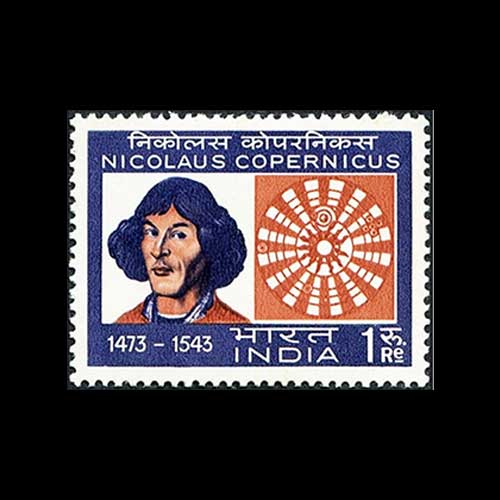
‘De Revolutionibus Orbium Coelestium’ was published in early 1543, the same year Copernicus passed away on 24 May. In recognition of his monumental contributions to mathematics and science, as well as his enduring legacy, India Post issued a commemorative stamp on 21 July 1973. The design features a horizontal layout that includes a #portrait of Copernicus alongside a detailed representation of the heliocentric universe, symbolizing his revolutionary cosmological model.
Latest News
-
Science and Technology on Indian Postage Stamps-23
2025-12-31 WedGuglielmo Marconi was an esteemed Italian engineer, inventor, and POLITICIAN recognized for his grou...
-
Science and Technology on Indian Postage Stamps-21
2025-12-30 TueLeprosy, also known as Hansen’s disease, is a chronic infectious disease caused by the bacterium M...
-
Science and Technology on Indian Postage Stamps-20
2025-12-29 MonVikram Sarabhai, ‘Father of the Indian Space Program,’ played a pivotal role in the advancement ...
-
Science and Technology on Indian Postage Stamps-19
2025-12-26 FriSir Chandrasekhara Venkata Raman, widely recognized as C.V. Raman, was a distinguished Indian physic...
-
Science and Technology on Indian Postage Stamps-18
2025-12-23 TueIn the 1950s, the United States and the Soviet Union were engaged in a significant Competition known...