
Science and Technology on Indian Postage Stamps-21
2025-12-30 Tue
Leprosy, also known as Hansen’s disease, is a chronic infectious disease caused by the bacterium Mycobacterium leprae. This condition is often feared due to its potential to cause physical deformities, which has historically contributed to the social stigma associated with it. Leprosy is primarily transmitted through respiratory droplets from the nose and mouth during close and frequent contact with untreated individuals. In India, Anti-Leprosy Day is observed annually on 30 January, coinciding with the Death anniversary of Mahatma Gandhi, who was a prominent advocate for the Rights of leprosy patients.Gerhard Henrik Armauer Hansen, popularly known as Dr Hansen, a Norwegian physician, is recognized for his discovery of Mycobacterium leprae, also referred to as Hansen’s bacillus, the causative agent of leprosy.
According to M. A. Gonzalez Prendes in his work titled 'Gerhard Henrik Armauer Hansen (1841-1912),' published in 1963, Norway had the highest prevalence of leprosy and the most advanced understanding of the disease in 19th-century Europe. The presence of leprosy in Norway can be traced back to ancient times and is believed to have been introduced by Vikings from Great Britain and Ireland.
Dr Hansen was born on 29 July 1841, in the town of Bergen, Norway. Coming from a humble background, he undertook various jobs to pursue Education. He studied Medicine at the University of Christiania (now the University of Oslo), graduating with honors in 1866. Following his internship at the Rikshospitalet (now Oslo University Hospital), he accepted a position as a physician in the small fishing village of Lofoten but later returned to Bergen, the hub of European leprosy research.
During this period, Norway was home to approximately 3,000 leprosy patients, more than any other European nation, with the majority concentrated in Bergen, which housed three leprosy hospitals. Dr. Hansen initially worked at Pleiestiftelsen for spedalske nr 1 and subsequently became an assistant physician at Lungegaardshospitalet, under the guidance of Dr. Daniel Cornelius Danielssen, a leading expert on the clinical and pathological dimensions of leprosy.
While Danielssen regarded leprosy as hereditary, Dr. Hansen asserted that it was transmitted by a bacterium from person to person. This assertion was groundbreaking at a time when the concept of contagion was not fully understood and the role of bacteria in human diseases remained unproven.
In 1869, Dr. Hansen published his examination of the microscopic anatomy of lymph nodes, in which he identified yellowish-brown granular masses. Between 1870 and 1871, he traveled to Bonn and Vienna to acquire the training necessary to substantiate his hypothesis. He successfully identified the infectious agent in leprous material in 1873, culminating in his historic publication.
In recognition of his significant contributions, Dr. Hansen was appointed Chief Medical Officer for Leprosy in Norway in 1875. He strongly believed in the necessity of isolating leprosy patients to hinder the transmission of the disease and implemented a series of legislative measures to facilitate this process in Norway, which led to a marked decline in cases.
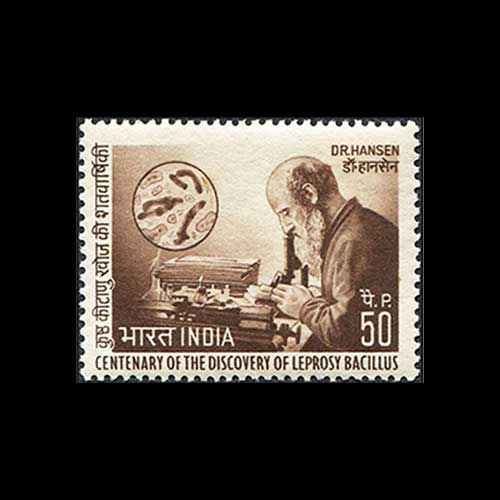
Dr. Hansen passed away on 12 February 1912, due to a heart attack. To honor the centenary of his discovery of the leprosy bacillus, India Post issued a commemorative stamp on 21 July 1973. The stamp features a portrait of Dr. Hansen observing through a microscope, alongside a Petri dish containing bacilli, symbolizing his pivotal scientific achievement.
Latest News
-
Science and Technology on Indian Postage Stamps-20
2025-12-29 MonVikram Sarabhai, ‘Father of the Indian Space Program,’ played a pivotal role in the advancement ...
-
Science and Technology on Indian Postage Stamps-19
2025-12-26 FriSir Chandrasekhara Venkata Raman, widely recognized as C.V. Raman, was a distinguished Indian physic...
-
Science and Technology on Indian Postage Stamps-18
2025-12-23 TueIn the 1950s, the United States and the Soviet Union were engaged in a significant Competition known...
-
Silver Tanka of Malwa Sultan Nasir Shah
2025-12-22 MonIn silver, the #Malwa Sultan Nasir Shah (r. 906–916 AH / 1500–1511 CE) issued coins in two broad...
-
Science and Technology on Indian Postage Stamps-17
2025-12-22 MonArdaseer Cursetjee Wadia, a stalwart in the field of engineering, was born on 06 October 1808 in Sur...