
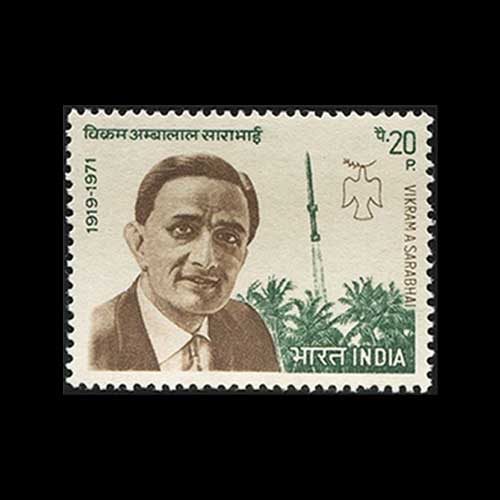
Science and Technology on Indian Postage Stamps-20
2025-12-29 Mon
Vikram Sarabhai, ‘Father of the Indian Space Program,’ played a pivotal role in the advancement of space Research and nuclear Power in India. Born on 12 August 1919, in Ahmedabad, Gujarat, he was the son of Ambalal Sarabhai, a prominent textile mill owner and a passionate advocate for the Indian independence movement.Sarabhai's early talent was recognized when he received a blessing from Rabindranath Tagore at the age of seven, who predicted that he would achieve great things. From a young age, Sarabhai cultivated a profound interest in science. At just 15 years old, he constructed a functional model of a train engine with assistance from two engineers, and this model is now exhibited at the Community Science Centre (CSC) in Ahmedabad.
After completing his education at Gujarat University, Sarabhai pursued further studies in physics and mathematics at Cambridge University. His academic journey was interrupted by World War II, prompting his return to India. He later earned a post-graduate degree at the Indian Institute of Science in Bengaluru under the esteemed Dr. C.V. Raman, where he also met Dr. Homi Bhabha. He published his first scientific paper, ‘Time Distribution of Cosmic Rays,’ in the Proceedings of the Indian Academy of Sciences in 1942, merely two years after commencing his research. He returned to Cambridge in 1945 to continue his investigations on cosmic rays and photo fission, ultimately obtaining his PhD in 1947 for his thesis titled ‘Cosmic Ray Investigations in Tropical Latitudes’.
Upon his return to India in 1947, Sarabhai dedicated himself to establishing the Physical Research Laboratory (PRL) in Gujarat, which became an institution dedicated to fundamental research in cosmic rays, aeronomy, and space sciences. After successfully securing funding, he invited Dr. C.V. Raman to inaugurate the PRL building in 1952, an event attended by other luminaries in the scientific community, including Homi Bhabha and S.S. Bhatnagar. The PRL later received support from the Council of Scientific and Industrial Research (CSIR) and the Department of Atomic Energy.
Sarabhai foresaw new avenues for exploration in the fields of Solar and interplanetary physics. The period designated as the International Geophysical Year (IGY) in 1957-1958 marked a significant point in Sarabhai's career, as it allowed India to participate in a prominent international scientific initiative coinciding with the launch of Sputnik-I in 1957. This engagement led to the formation of the Indian National Committee for Space Research (INCOSPAR), which he chaired.
Understanding the strategic advantage of Thumba due to its proximity to the geomagnetic equator, Sarabhai selected this fishing village near Thiruvananthapuram on the Arabian coast to establish the Thumba Equatorial Rocket Launching Station (TERLS), India’s first rocket launching facility. He was instrumental in the development of indigenous rockets at Thumba, including the Rohini and Menaka series. This initiative received notable support from Homi Bhabha, who served as the Chairman of the Atomic Energy Commission at that time. The inaugural launch of a Rocket occurred on 21 #November, 1963, and in 1965, the UN General Assembly recognized TERLS as an international facility.
Following the Death of Homi Bhabha, Sarabhai assumed the role of Chairman of the Atomic Energy Commission in 1966. He also engaged in discussions with NASA, which laid the groundwork for the Satellite Instructional Television Experiment. Launched in 1975 from Pij village in Gujarat’s Kheda district, this program was designed to deliver educational television programming to rural communities and marked the first Indo-U.S. space collaboration using technology for educational purposes, which ultimately led to the development of the "Krishi Darshan" program for farmers on Doordarshan.
Vikram Sarabhai was honored with several prestigious accolades throughout his career, including the Shanti Swarup Bhatnagar Medal in 1962, the Padma Bhushan in 1966, and the Padma Vibhushan (posthumously) in 1972. He passed away on 30 December 1971, in Kovalam, Kerala. To commemorate his significant contributions, India Post issued a stamp on 30 December 1972, marking his first Death Anniversary. The stamp features a portrait of Dr. Vikram Sarabhai alongside a depiction of a rocket, "Rohini," and a peace dove.
Latest News
-
Science and Technology on Indian Postage Stamps-21
2025-12-30 TueLeprosy, also known as Hansen’s disease, is a chronic infectious disease caused by the bacterium M...
-
Science and Technology on Indian Postage Stamps-19
2025-12-26 FriSir Chandrasekhara Venkata Raman, widely recognized as C.V. Raman, was a distinguished Indian physic...
-
Science and Technology on Indian Postage Stamps-18
2025-12-23 TueIn the 1950s, the United States and the Soviet Union were engaged in a significant Competition known...
-
Silver Tanka of Malwa Sultan Nasir Shah
2025-12-22 MonIn silver, the #Malwa Sultan Nasir Shah (r. 906–916 AH / 1500–1511 CE) issued coins in two broad...
-
Science and Technology on Indian Postage Stamps-17
2025-12-22 MonArdaseer Cursetjee Wadia, a stalwart in the field of engineering, was born on 06 October 1808 in Sur...