
Science and Technology on Indian Postage Stamps-19
2025-12-26 Fri
Sir Chandrasekhara Venkata Raman, widely recognized as C.V. Raman, was a distinguished Indian physicist renowned for his groundbreaking contributions to the field of light scattering. As the first Asian and non-White recipient of the Nobel Prize in Physics, C.V. Raman was born on 07 November 1888, in Tiruchirapalli, Tamil Nadu. His family later relocated to Visakhapatnam in Andhra Pradesh, where his father served as a lecturer in mathematics and physics. Raman pursued his early Education in local institutions and subsequently earned a scholarship to attend Presidency College in Madras for his undergraduate studies.As documented in 'C.V. Raman: A Memoir' (1989) by A. Jayaraman, Raman completed his Bachelor of Arts degree in 1904 at the age of 15, achieving first place and receiving GOLD medals in both English and Physics. Following the recommendation of a teacher, he applied for the Indian Civil Services. However, at that time, aspiring candidates were required to Travel to England to take the examination, which was not feasible for him due to Health reasons. He subsequently joined the Financial Civil Services, where he was appointed as an Assistant Accountant-General in Calcutta (Kolkata).
In their 1998 paper titled 'Sir C.V. Raman and the Story of the Nobel Prize,' authors Rajinder Singh and Falk Riess highlight that Raman, in his spare time, began investigating various problems in acoustics at the Indian Association for the Cultivation of Science, which was founded by Mahendra Lal Sarkar, a physician and doctor, following the model of the Royal Institution in London. For almost a decade, he conducted independent research, establishing his reputation as a scientist both domestically and internationally. In 1917, he was appointed to the prestigious Palit Chair of Physics at the University of Calcutta.
Raman's first international trip occurred in 1921 when he attended the Congress of Universities of the British Empire held at Oxford, representing the University of Calcutta. His lecture at the Physical Society of London, where he presented his latest research in optics and acoustics, was well-received by numerous physicists.
During a return voyage from England, Raman contemplated the blue color of the Mediterranean Sea and, utilizing basic optical equipment, examined the seawater. He assessed several existing hypotheses regarding the sea's color—predominantly Lord Rayleigh's proposition that it resulted from reflected sky-light. Raman's research revealed that the blue color is attributed to molecular diffraction rather than sky REFLECTION or Absorption. He published his findings in an article titled 'The Color of the Sea,' which appeared in the November 1921 issue of Nature. By 1924, Raman’s exceptional research had garnered him international acclaim, leading to his election as a Fellow of the Royal Society (F.R.S.) in London.
These initial investigations initiated a significant avenue for further research in Calcutta and culminated in the discovery of the Raman Effect in 1928. This phenomenon describes the alteration in the Frequency of monochromatic light following scattering, with the spectrum of the scattered light providing insights into the molecular structure of materials. This pivotal discovery earned C.V. Raman the Nobel Prize in Physics in 1930.
Among his many accomplishments, C.V. Raman founded the Indian Journal of Physics in 1926, became the first Indian director of the Indian Institute of Science in Bengaluru, established the Indian Academy of Sciences in 1934, and founded the Raman Research Institute in Bengaluru in 1948.
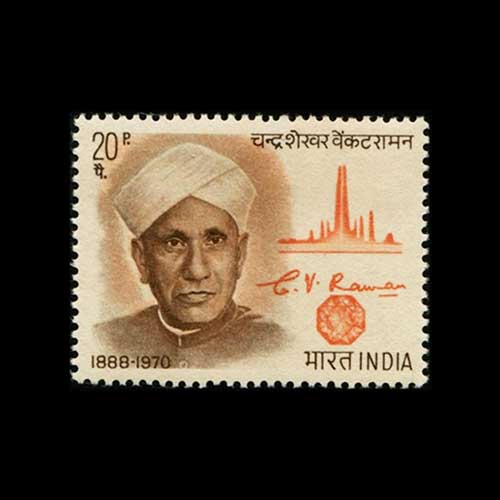
C.V. Raman passed away after a brief illness on 21 November 1970. As the Raman Effect was discovered on 28 February 1928, the day is celebrated annually as the National Science Day in India. To honor this esteemed physicist on the first anniversary of his passing, India Post issued a commemorative stamp featuring a portrait of C.V. Raman, his signature, a Diamond, and a representation of the Raman spectrum on 21 November 1971.
Latest News
-
Science and Technology on Indian Postage Stamps-18
2025-12-23 TueIn the 1950s, the United States and the Soviet Union were engaged in a significant Competition known...
-
Silver Tanka of Malwa Sultan Nasir Shah
2025-12-22 MonIn silver, the #Malwa Sultan Nasir Shah (r. 906–916 AH / 1500–1511 CE) issued coins in two broad...
-
Science and Technology on Indian Postage Stamps-17
2025-12-22 MonArdaseer Cursetjee Wadia, a stalwart in the field of engineering, was born on 06 October 1808 in Sur...
-
Science and Technology on Indian Postage Stamps-16
2025-12-20 SatThe launch of India’s first combat warship, the frigate INS Nilgiri (F33), in 1968 marked a signif...
-
Science and Technology on Indian Postage Stamps-15
2025-12-20 SatThe International Geographical Union (IGU) is a distinguished non-governmental organization committe...