
Science and Technology on Indian Postage Stamps-18
2025-12-23 Tue
In the 1950s, the United States and the Soviet Union were engaged in a significant Competition known as the Space race. This competition, which began during the COLD War, focused on achieving milestones in space exploration beyond Earth's atmosphere. On 12 April 1961, Yuri Gagarin from the Soviet Union became the first human to travel into space. Less than a month later, Alan Shepard made History as the first American in space. In response to these achievements, former President of #USA John F. Kennedy challenged the National Aeronautics and Space Administration (NASA) to land a human on the Moon within ten years.This challenge gave rise to the Apollo program (1961-1972), also referred to as project Apollo, which was the USA's initiative to send humans to the Moon under NASA's direction. The Apollo program consisted of 11 missions, with the inaugural FLIGHT taking place in 1968. The initial four flights served to test the spacecraft, while six of the subsequent seven missions successfully landed on the LUNAR Surface.
The historic first Moon landing took place on 20 July 1969, during the Apollo 11 mission, marking a monumental moment as humans set foot on another celestial body for the first time. The mission launched from Kennedy Space Center in Florida, carrying astronauts Neil Armstrong, Michael Collins, and Buzz Aldrin. Prior to the landing, the crew divided their responsibilities: Collins remained with the command module, Columbia, to orbit the Moon, while Armstrong and Aldrin descended to the lunar module, Eagle. The lunar module undertook a challenging landing in a shallow crater named the 'Sea of Tranquility'. Armstrong and Aldrin then conducted their historic moon walk, with Armstrong being the first person to step onto the lunar surface. His famous words, "That's one small step for [a] man; one giant leap for mankind," have since become emblematic of this monumental achievement. The astronauts collected a total of 47 pounds of lunar Rock and dust samples during their mission.
They spent 21 hours on the Moon's surface, including a seven-hour rest period, before returning to Earth. The crew safely returned on 24 July 1969, and in the following years, an additional ten astronauts embarked on lunar missions. The final mission of the Apollo program took place in 1972.
After their successful Moon landing, the Apollo 11 crew participated in a goodwill tour spanning 38 days, named the ‘Giant Step Apollo Tour,’ which included visits to 29 cities in 24 countries. Notably, on 26 October, Neil Armstrong, Edwin “Buzz” Aldrin, and Michael Collins visited Mumbai.
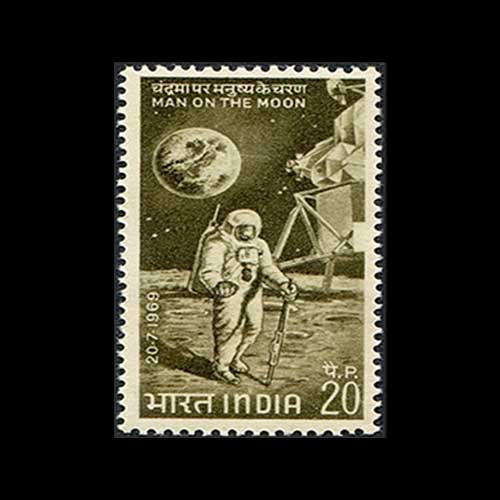
In recognition of this historic achievement, numerous countries around the world issued stamps and coins celebrating the Moon landing. On 19 November 1969, #India #post issued a 20 paise commemorative stamp featuring an astronaut on the lunar surface, with Earth depicted in the background.
Latest News
-
Silver Tanka of Malwa Sultan Nasir Shah
2025-12-22 MonIn silver, the #Malwa Sultan Nasir Shah (r. 906–916 AH / 1500–1511 CE) issued coins in two broad...
-
Science and Technology on Indian Postage Stamps-17
2025-12-22 MonArdaseer Cursetjee Wadia, a stalwart in the field of engineering, was born on 06 October 1808 in Sur...
-
Science and Technology on Indian Postage Stamps-16
2025-12-20 SatThe launch of India’s first combat warship, the frigate INS Nilgiri (F33), in 1968 marked a signif...
-
Science and Technology on Indian Postage Stamps-15
2025-12-20 SatThe International Geographical Union (IGU) is a distinguished non-governmental organization committe...
-
Science and Technology on Indian Postage Stamps-14
2025-12-09 TueMarie Curie, a distinguished POLISH-born physicist and chemist, is widely recognized as one of the m...