
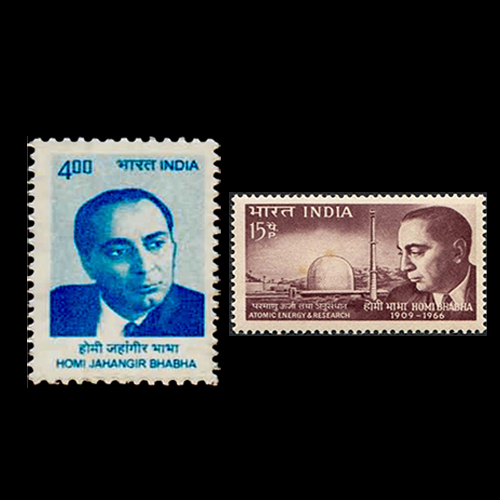
Science and Technology on Indian Postage Stamps-11
2025-12-05 Fri
Dr. Homi Jehangir Bhabha was one of India's most esteemed scientists and is widely recognized as the ‘Father of the Indian Nuclear programme.’ Born in Bombay (now Mumbai) on 30 October 1909, he was named Homi after his paternal grandfather, Dr Hormusji Bhabha, who held the position of Inspector-General of Education in the Princely State of Mysore.Dr. Bhabha received his early education at the Cathedral and John Connon School in Bombay, where he developed a profound interest in science. Following this, he attended Elphinstone College and the Royal Institute of Science in Bombay before being sent to Cambridge for further studies in 1927. Initially enrolled in Engineering to comply with his father's wishes for him to join Tata Industries, Dr. Bhabha soon discovered his passion for theoretical Physics and mathematics. He communicated this change of focus in a letter to his father, who ultimately permitted him to pursue physics on the condition that he excelled in his Mechanical Engineering degree. Dr. Bhabha successfully achieved a first-class result in June 1930, thereby allowing him to fully devote himself to theoretical physics.
At Cambridge, Dr. Bhabha joined the Cavendish laboratory, where he earned his PhD under the guidance of R.H. Fowler. During this period, he made significant contributions to the field, including his work on relativistic exchange scattering, known as Bhabha Scattering, and the Bhabha-Heitler theory concerning the production of electron and positron showers in cosmic rays.
In 1939, Dr. Bhabha returned to India for a holiday; however, the onset of the Second World War altered his plans. He subsequently joined the Indian Institute of Science in Bangalore, where a special Readership in Theoretical Science was created for him. During his tenure there, he delivered 25 lectures on his research in Cosmic rays. In 1940, the Sir Dorabji Tata Trust supported his experimental cosmic ray physics research with a grant. Later in 1945, the Tata Institute of Fundamental Research (TIFR) was established with a grant from the Sir Dorabji Tata Trust. Dr. Bhabha assumed the role of its first Chairman.
The Atomic Energy Committee was established in 1945, predating both the United States atomic bomb testing and the subsequent bombings in Japan. Recognizing the lack of an Indian institution dedicated to nuclear studies, a research program in this area was initiated at TIFR, with committee meetings commencing in 1946. Shortly after India's independence, the Board of Research on Atomic Energy was set up on 26 August 1947, and by 1948, the Indian Atomic Energy Act was enacted.
Dr. Bhabha's vision was pivotal in the establishment of the Atomic Energy Commission (AEC) within the Department of Scientific Research. On 3rd January 1954, the Commission resolved to construct an Atomic Energy Establishment at Turbhe or Trombay (AEET). Utilizing the authority granted by the Indian Atomic Energy Act of 1948, the Department of Atomic Energy (DAE) was created as a separate Ministry in August 1954. Earlier that year, Dr. Bhabha was honored with the Padma Bhushan by the Government of India, and in 1955, he led the inaugural United Nations conference on the Peaceful Uses of Atomic Energy in Geneva. Interestingly, he was nominated for the Nobel Prize five times but never received the honor.
Dr. Homi Bhabha lost his life in a #plane crash near Mont Blanc in the Swiss Alps in 1966. In acknowledgment of his substantial contributions, the Atomic Energy Establishment was renamed the Bhabha Atomic Research Centre (BARC). Additionally, India Post issued two stamps honoring Dr. Bhabha: a commemorative stamp on 04 August 1966 and a definitive stamp in 2009.
Latest News
-
Science and Technology on Indian Postage Stamps-10
2025-12-05 FriIn the mid-19th Century, the geological community in Europe and North America recognized the need fo...
-
Science and Technology on Indian Postage Stamps-9
2025-12-04 ThuWaldemar Mordechai Wolff Haffkine was a distinguished Russian-French bacteriologist renowned for his...
-
Gold Tanka of Malwa Sultan Nasir Shah
2025-12-04 ThuNasir Shah, the son of Ghiyath Shah, ascended to the throne of the Malwa Sultanate in the Hijri year...
-
Science and Technology on Indian Postage Stamps-8
2025-12-04 ThuAcharya Prafulla Chandra Ray is regarded as one of the most distinguished scientists and industriali...
-
Science and Technology on Indian Postage Stamps-7
2025-11-29 SatAkashvani, also known as All India Radio (AIR), was established in 1936 and functions under the Mini...