
Science and Technology on Indian Postage Stamps-10
2025-12-05 Fri
In the mid-19th Century, the geological community in Europe and North America recognized the need for an international Congress. This recognition led to the establishment of the International Geological Congress (IGC), initiated by a suggestion from the American Association for the Advancement of Science during their meeting in Buffalo, New York, in 1875.The IGC is a non-profit Scientific and educational organization, with its meetings sponsored by the International Union of Geological Sciences (IUGS). As a flagship event of the IUGS, the Congress attracts several thousand participants from around the world. It is held every four years at a venue designated by the IUGS Council during the IUGS General Assembly. The primary objective of the Congress is to foster the advancement of both fundamental and applied research in the #Earth sciences on a #Global scale. The inaugural session of the IGC took place in #Paris in 1878.
A significant milestone in the History of the IGC occurred when India hosted its 22nd session in New Delhi from 14 - 22 December 1964, marking the first time the Congress was held in Asia. Dr. D.N. Wadia, National professor of geology and Geological Adviser to the government of India’s Department of Atomic Energy, was elected as the President of the Congress's policy-making body.
The event was inaugurated by Dr. Sarvepalli Radhakrishnan, the former President of India, and provided an occasion to highlight the advancements, contributions, and achievements of Indian geology. It included the contributions of Geological Survey of India, one of the oldest national Surveys, in the fields of stratigraphy, palaeontology, and orology. The Congress was attended by over 600 delegates from approximately 100 countries.
Another noteworthy aspect of the IGC was the exhibition of geological maps, publications, instruments, and other Materials. 25 countries participated in these displays, allowing geologists to showcase their latest discoveries. India presented maps of the entire country at scales of 1:5,000,000 and 1:2,000,000, which required thirty years of effort to complete. Additionally, metallogenic, mineralogical, and tectonic maps at a scale of 1:2,000,000 were exhibited, along with specialized maps of coal regions, GOLD fields, copper-bearing areas, gypsum locations, and the western Himalayas.
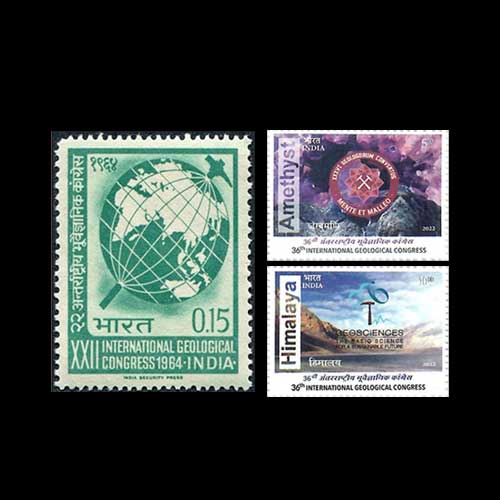
On 14 December 1964, India Post issued a commemorative stamp to celebrate the convening of the IGC in India, featuring a face value of 15 paise. The #design of the stamp displays the Earth, symbolizing the focus of geological study, with the geological hammer depicted as the axis of the globe.
Moreover, the 36th International Geological Congress, under the theme “Geosciences: The Basic Science for a Sustainable Future,” was initially scheduled to occur in Delhi from 02 - 08 March 2020. However, due to the COVID?19 pandemic, the event was postponed and successfully conducted on a Virtual platform from 20-22 March 2022. This Congress was a collaborative initiative involving the Ministry of Mines, the Ministry of Earth Sciences, the Indian National Science Academy, and the Science Academies of Bangladesh, Nepal, and SriLanka.
In honor of this significant event, India Post issued two commemorative postage stamps on 20 March 2022: one featuring the Amethyst with a face value of ?5 and the other depicting the Himalayas with a face value of ?10.
Latest News
-
Science and Technology on Indian Postage Stamps-9
2025-12-04 ThuWaldemar Mordechai Wolff Haffkine was a distinguished Russian-French bacteriologist renowned for his...
-
Gold Tanka of Malwa Sultan Nasir Shah
2025-12-04 ThuNasir Shah, the son of Ghiyath Shah, ascended to the throne of the Malwa Sultanate in the Hijri year...
-
Science and Technology on Indian Postage Stamps-8
2025-12-04 ThuAcharya Prafulla Chandra Ray is regarded as one of the most distinguished scientists and industriali...
-
Science and Technology on Indian Postage Stamps-7
2025-11-29 SatAkashvani, also known as All India Radio (AIR), was established in 1936 and functions under the Mini...
-
Science and Technology on Indian Postage Stamps-6
2025-11-12 WedSir Mokshagundam Visvesvaraya is regarded as one of India's most distinguished engineers. His innova...