
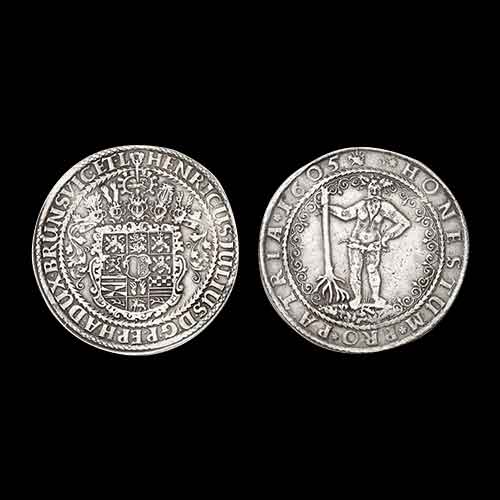
Silver Wildman Taler
2022-09-14 Wed
One of the most famous Germanic coins is the “Wildman taler.” Wildman taler was influenced by pagan tradition in the Harz Mountain region of Germany, where the wildman appears in folklore and other forms of art but not many coins feature this pagan mythological creature.The Harz was a major silver-producing region and the imagery is a reference to the mining city Wildemann and the legend of its foundation. As the story goes, in 1529, miners who were sent out to find new ore deposits discovered a wild man who lived with a wild woman. They captured him, but he died as a result of his injuries. Large silver ore deposits were reportedly discovered where he had lived.
The Wildman, according to Germanic Coinages was the medieval European equivalent of the American Bigfoot or Sasquatch. Typical Wildman coins show a gigantic beast, usually hairy and muscled, wearing a loincloth of leaves, with only its hands and feet free of fur. The creature is often seen grasping the trunk of a tree, sometimes with a city or forest in the background.
Image Courtesy: coinworld.com
Latest News
-
Elephant on a Punch-Marked Coin of the Vidarbha Janapada
2026-09-23 WedThe history of Indian coinage begins with the remarkable tradition of punch-marked coins, among t...
-
Gandabherunda and Four Elephants on a Gold Half Varaha of Achyutadevaraya
2026-09-23 WedThe Gandabherunda, the mythical two-headed bird of Indian tradition, is one of the most striking ...
-
The Elephant on an Indo-Greek Silver Drachm of Apollodotus I
2026-09-22 TueElephants were not just an important part of Indian heritage and religious traditions; they also ...
-
Gajalakshmi Flanked by Elephants on a Post-Mauryan Ujjaini Copper Coin
2026-09-22 TueThe association between Gajalakshmi and elephants is one of the most enduring motifs in Indian re...
-
Elephant Head on a Bronze Coin of Indo-Scythian King Maues
2026-09-21 MonAs the eighth day of Ganesh Utsav is celebrated, the elephant once again provides a fascinating l...