
The Rarest Coin of the Romano-Gallic Empire
2022-05-21 Sat
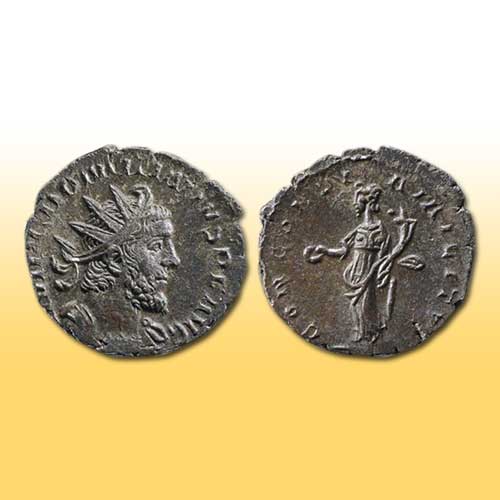
The Rarest Coin of the Romano-Gallic Empire is a double-denarius issued sometime between 269 and 271 by Domitianus. The first coin was discovered in France in 1900, and the second, now in the Ashmolean Museum, was found in the village of Chalgrove in Oxfordshire, in 2003.Domitianus II was a Roman soldier of the mid-third century AD who was acclaimed Emperor, probably in northern Gaul, in late 270 or early 271 AD and struck coins to advertise his elevation. Domitianus' reign lasted only a few weeks, and with no literary references to his being emperor, the only evidence for his existence and rule derives from two coins.
The design of both coins is typical of those associated with the 'Gallic Empire'. They are of the "radiate" type and depict Domitianus as a bearded figure wearing a spiky or radiate crown representing the rays of the sun, and bearing the legend, IMP C DOMITIANUS P F AUG, an abbreviation for 'Imperator Caesar Domitianus Pius Flavius Augustus'.
Image Courtesy: coinworld.com
Latest News
-
Elephant on a Punch-Marked Coin of the Vidarbha Janapada
2026-09-23 WedThe history of Indian coinage begins with the remarkable tradition of punch-marked coins, among t...
-
Gandabherunda and Four Elephants on a Gold Half Varaha of Achyutadevaraya
2026-09-23 WedThe Gandabherunda, the mythical two-headed bird of Indian tradition, is one of the most striking ...
-
The Elephant on an Indo-Greek Silver Drachm of Apollodotus I
2026-09-22 TueElephants were not just an important part of Indian heritage and religious traditions; they also ...
-
Gajalakshmi Flanked by Elephants on a Post-Mauryan Ujjaini Copper Coin
2026-09-22 TueThe association between Gajalakshmi and elephants is one of the most enduring motifs in Indian re...
-
Elephant Head on a Bronze Coin of Indo-Scythian King Maues
2026-09-21 MonAs the eighth day of Ganesh Utsav is celebrated, the elephant once again provides a fascinating l...