
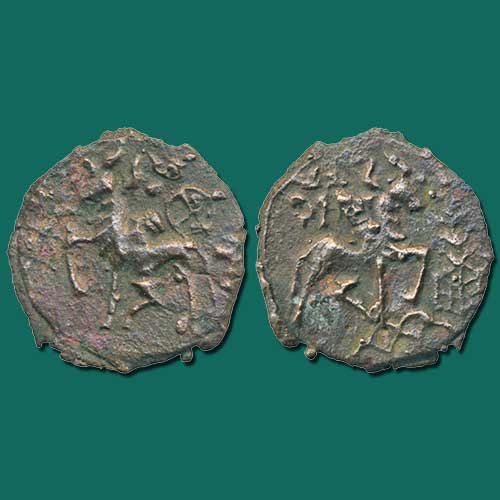
Copper Coin of City State of Kaushambi
2020-03-12 Thu
Kaushambi is one of the districts situated in the Indian States of Uttar Pradesh. During the ancient period, it was the capital of Vatsa Mahajanapada, one of the 16th Mahajanapadas of India. Kaushambi continued to remain as one of the important cities of India from the Vedic period until the end of the Mauryan Empire with occupation continuing until the Gupta Empire.It was one of the major pilgrimages centers for Buddhism during the ancient period. It is also believed that Lord Buddha had delivered many of his sermons here. Being one of the most important centers of Buddha; this place also has several landmarks associated with Buddha. This place is also an important pilgrimage for Jain followers; many Jain followers come here to pay homage at Digambar Jain Temple.
This copper coin which weighs around 3.43g was issued from Kaushambi. The obverse side of this coin depicts standing bull facing towards left with a symbol on its back. The reverse of this coin depicts standing bull facing towards the right with a symbol on its back and tree-in-railing in front.
Image Courtesy: Todywalla Auction\
Latest News
-
Goddess Lakshmi in Padmasana Posture on a Rare Kakatiya Gold Gadyana Coin
2026-11-19 ThuThe Kakatiya dynasty was an important ruling power in the Deccan, with its influence centred arou...
-
Chalukyan-style Temple on Gold Gadyana
2026-11-19 ThuThe Chalukyas of Kalyani, also known as the Western Chalukyas, were an influential ruling dynasty...
-
An Interesting Five-Symbols on Punch-Marked Copper Square Karshapana of Eran
2026-11-18 WedThe ancient region of Eran, situated in present-day Madhya Pradesh, was an important centre of ea...
-
Sacred Symbols and Natural Motifs on Post-Mauryan Coinage of the Eran-Vidisha Region
2026-11-18 WedThe decline of the Mauryan Empire in the second century BCE marked the emergence of several regio...
-
Mithuna (Couple) Type Coin from the Post-Mauryan Ujjaini Region
2026-11-17 TueContinuing our exploration of the distinctive coinage of the Post-Mauryan Ujjaini region, let us ...