
Science and Technology on Indian Postage Stamps-14
2025-12-09 Tue
Marie Curie, a distinguished POLISH-born physicist and chemist, is widely recognized as one of the most influential scientists in history. Her pioneering research on radioactivity significantly advanced the fields of radiology and Medicine. Born in Warsaw on 07 November 1867, as Marie Sklodowska, she achieved several milestones as the first woman to win a Nobel Prize, the first individual to receive a Nobel Prize on two occasions, and the only person honored with Nobel Prizes in two distinct scientific disciplines.She received initial education in local schools and acquired scientific Training from her father. Her involvement in a student revolutionary organization led her to leave Warsaw, which was then under Russian control. In 1891, she relocated to Paris to continue her studies, ultimately earning Licenciateships in Physics and the Mathematical Sciences. It was in 1894 that she met Pierre Curie, a professor in the School of Physics, and they were married the following year.
Under Pierre's guidance, Marie Curie began to explore the properties of radiation, a phenomenon initially discovered by Henri Becquerel. In 1898, she and Pierre made the groundbreaking discovery of two new radioactive chemical elements—polonium and radium—found in trace amounts within uranium ores. In 1903, she obtained her Doctor of Science degree and, notably, she and Pierre were jointly awarded the Nobel Prize in Physics, alongside Henri Becquerel.
Following the death of Pierre Curie in 1906, Marie assumed his position as Professor of General Physics in the Faculty of Sciences at Sorbonne (University of Paris), marking a historic moment as the first woman to hold this role. She continued her research, and her successful isolation of pure radium further solidified her reputation, ultimately leading to her second Nobel Prize in Chemistry in 1911.
In 1914, she established the Radium Institute in Paris, a prominent laboratory dedicated to research on radiation and its biological effects. This institution later became an international model for studying radioactive materials and utilizing radiation in Cancer treatment. Her contributions were instrumental in the development of X-ray Technology for surgical applications. During World War I, she developed mobile radiography units, referred to as "Little Curies," which provided X-ray diagnostics on the Battlefield, thereby significantly enhancing the treatment of wounded Soldiers. She was appointed by the International Red Cross as the head of its radiological service, where she also organized Training courses for Medical personnel in these innovative techniques.
In 1922, she was elected as a member of the French Academy of Medicine and participated in the International Committee on Intellectual Cooperation of the League of Nations. Under her direction, significant advancements in radiation research continued at the Radium Institute, culminating in the discovery of artificial radioactivity by Irene and Frederic Joliot-Curie in 1934, for which they received the Nobel Prize in Chemistry the following year.
Despite her remarkable achievements, Marie Curie faced substantial resistance from male colleagues in France and did not receive appropriate financial recognition for her contributions. She passed away in 1934 in France from aplastic anemia, a condition likely resulting from her long-term exposure to radiation during her research and medical work in field hospitals during World War I.
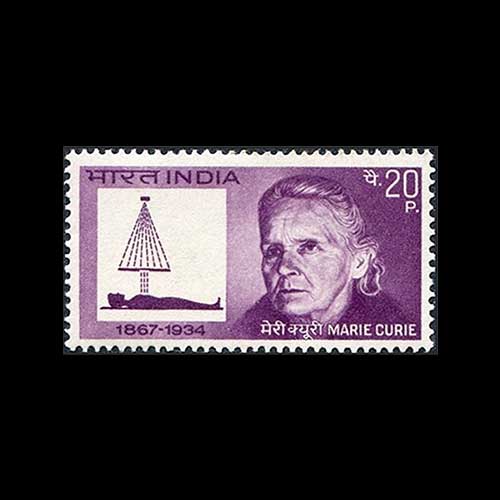
On 06 November 1968, India post issued a commemorative stamp honoring her birth centenary, featuring her portrait on one side and an illustration of a patient receiving radiation therapy on the other, thus emphasizing her enduring scientific Legacy.
Latest News
-
Science and Technology on Indian Postage Stamps-13
2025-12-08 MonWheat is recognized as the second most crucial staple Food crop in India, following rice, and plays ...
-
Science and Technology on Indian Postage Stamps-12
2025-12-08 MonThe survey of India (SOI) serves as the principal mapping and surveying agency across the country. E...
-
Science and Technology on Indian Postage Stamps-11
2025-12-05 FriDr. Homi Jehangir Bhabha was one of India's most esteemed scientists and is widely recognized as the...
-
Science and Technology on Indian Postage Stamps-10
2025-12-05 FriIn the mid-19th Century, the geological community in Europe and North America recognized the need fo...
-
Science and Technology on Indian Postage Stamps-9
2025-12-04 ThuWaldemar Mordechai Wolff Haffkine was a distinguished Russian-French bacteriologist renowned for his...